

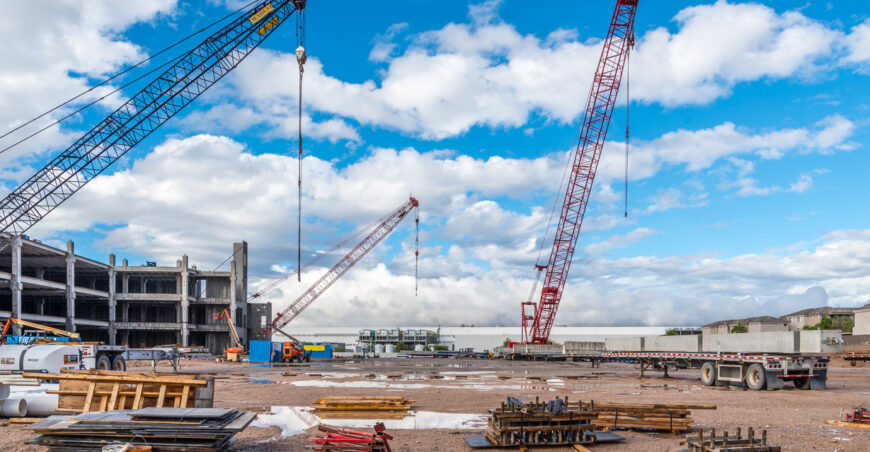
Phoenix office market outlook for the next two years hinges on a number that rarely makes headlines: how little new space is being built. CBRE reports that only 40,000 square feet of office remains under construction Valley-wide as of Q3 2026, a pipeline it describes as a near standstill.
That sounds odd when roughly one in four office square feet in the Valley still sits empty. But two things are happening at once. Almost no new office is being added, and older, obsolete buildings are being torn down or converted at a record pace.
The result is not a shortage of office space. It is a possible shortage of good office space in the right places, and that is a very different story for owners, investors, and tenants.
Five things every owner, investor, and tenant should know about the Phoenix office market outlook:
- The pipeline is almost empty. Valley-wide construction is down to about 40,000 SF, and no speculative office projects broke ground in Q2.
- Supply is shrinking from the other side, too. About 3.3 million SF has been demolished or converted since 2024, with 4.1 million SF more proposed.
- Demand is concentrating in the best buildings. Class A absorption in Q2 was the strongest in more than four years.
- Scarcity is a submarket story. Camelback, South Scottsdale, and Scottsdale Airpark look tight, while Metrocenter and Downtown still carry vacancy above 33%.
- The risk is demand, not supply. Smaller footprints, higher rates, and a slower job market could cool the recovery before scarcity shows up in rents.
This article explains what is driving the shift, where it is strongest, and how to respond.
Current Market Context
Vacancy is still high, and it depends on who is counting. Cushman & Wakefield put metro vacancy at 25.4% in Q2 2026, down 70 basis points in a single quarter and the fastest drop in more than a decade. Newmark measured 23.4% for the same quarter. Kidder Mathews reported 23.7% for Q3, down 10 basis points from a year earlier.
Each firm uses its own inventory definition, so the figures should not be compared directly. The direction is what matters. Vacancy is edging down, and Kidder Mathews measured Class A vacancy at 28.3%, Class B at 18.5%, and Class C at 11.1% in Q3.
Rents are holding near record levels. CBRE says average full-service asking rent stayed at an all-time high in Q3. Kidder Mathews put the Q3 average at $31.66 per SF, up 2% year over year, with Class A at $34.50. Cushman & Wakefield reported $30.47 in Q2, a slight 0.3% dip from its Q1 record.
Two other signals matter. Sublease vacancy fell to 2.9 million SF in Q2 per Cushman & Wakefield, the tenth straight quarterly decline. Leasing volume, however, slowed to about 1.3 million SF in Q3 according to Kidder Mathews, so the recovery is real but not fast.
Phoenix Office Market Outlook: Construction Has Nearly Stopped. Is Scarcity Next?
The short answer: yes for functional Class A space in core submarkets, and no for the market as a whole. Three forces explain why.
1. Developers are not building
Colliers reported in Q1 that the Valley pipeline was at its lowest level, with just 184,500 SF under way in two build-to-suit buildings. Colliers pointed to limited capital for speculative office and the high rents needed to make new projects pencil.
Newmark found that no speculative office projects broke ground in Q2. Cushman & Wakefield’s only active project that quarter was the 144,500 SF Sprouts Farmers Market headquarters in Desert Ridge, a build-to-suit. The totals differ by firm and quarter because of timing and definitions, but they tell the same story.
Newmark has also said speculative development could return once trophy-space vacancy nears 10%. Class A vacancy is nowhere close to that today.
2. Old office is leaving the market
Cushman & Wakefield’s redevelopment research found 3.3 million SF across 37 buildings demolished or converted since 2024, more than the previous ten years combined. Another 4.1 million SF across 44 buildings is proposed. If every proposal moves forward, about 1.6 million SF of vacant space would leave the market, worth roughly 110 basis points of vacancy.
Tempe offers a clear example. Panattoni paid $37.5 million for the 25-acre former State Farm campus, which holds about 462,000 SF of office. Most of it will be replaced with a two-building industrial project.
Cushman & Wakefield also flagged 23 older office buildings, totaling 2.3 million SF, with loan maturities within five years. They are the most likely next candidates for sale, redevelopment, or conversion.
3. Demand is concentrating in the best space
Class A absorbed 341,135 SF in Q2, its strongest quarter since Q1 2022. Over the trailing twelve months, Class A absorbed about 1.0 million SF, compared with a 2014 to 2019 average of 990,410 SF. Total absorption over the same twelve months reached 1.3 million SF, a six-year high.
Size matters too. Buildings over 100,000 SF carry 29.2% vacancy, while buildings under 100,000 SF sit at 18.0%. Large, older floor plates are the hardest to fill.
So is scarcity really coming?
Not market-wide. Cushman & Wakefield counts about 19.0 million SF of direct vacant space. Even the full 1.6 million SF of removals would barely dent that.
What can tighten is the supply of modern, well-located, amenity-rich buildings. When tenants need 20,000 to 100,000 SF in Camelback or the Airpark, the list of real options is short, and no new buildings are coming to lengthen it.
Local Arizona Impact
The Phoenix office market outlook follows Phoenix growth. The University of Arizona’s forecasting team expects job growth of 1.1% in 2026 and 1.4% in 2027, with population growth of about 1.5% a year in the Phoenix metro (Eller College, Feb. 2026). Cushman & Wakefield reports 2.5 million jobs in the metro, up 20,500 year over year. Kidder Mathews says office-using employment rose 1.3% in July, the best annual pace since mid-2022.
Here is how that plays out by submarket, using Cushman & Wakefield’s Q2 2026 data unless noted:
- Scottsdale Airpark: 17.5% vacancy, +58,700 SF absorption, and a four-year high of 364,856 SF in leasing for the quarter. Rent averages $32.31.
- South Scottsdale and Camelback: South Scottsdale rents average $40.41 and Camelback leads the Valley at $43.02. Colliers reported Camelback rents up 6.3% to $44.79 in Q1, with two leases starting above $62 per SF.
- Tempe: 23.9% vacancy but +237,824 SF of absorption year to date. Tempe also carries the largest sublease block of any major market at 694,898 SF.
- Chandler and Gilbert: The Price/Chandler/Gilbert submarket led the metro with +191,794 SF of absorption in Q2, and vacancy fell 230 basis points to 25.2%.
- Mesa and Queen Creek: The Superstition Corridor shows 23.6% vacancy and rents near $23.54. East Mesa is at 20.8% with rents near $20.72. These are value-priced options, not tight markets.
- The weak spots: Metrocenter (34.9%) and Downtown (33.7%) remain the Valley’s softest submarkets, which is why many conversion proposals cluster there.
Looking ahead, Cushman & Wakefield expects net supply to fall over the next few years, and it counts more than 700,000 SF of signed leases still waiting to commence. If job growth lands near the Eller forecast, demand for quality space should keep pace with a shrinking supply of it.
National Impact
The Phoenix office market outlook is part of a national pattern. CoStar says about 50 million SF of office is under construction nationally, matching the 2011 cycle low, and total inventory shrank by 7 million SF over the past year, the first meaningful contraction in decades. CoStar put national vacancy just under 14% in Q2 2026.
Newmark’s national view is more cautious. It measured vacancy at 20.2% in Q1 and a 17.2 million SF pipeline, the lowest since 2012. The gap between CoStar and Newmark reflects methodology, but both point to the same thin pipeline.
Tenants are also using less space. Newmark says space per employee is down 7.5% since 2020, and average lease sizes are about 10.5% below pre-pandemic levels.
Capital markets add pressure. The Federal Reserve raised rates a quarter point to 3.75%–4% on Sept. 16, and the 10-year Treasury crossed 5%, according to Verdantix. Higher borrowing costs make new construction even harder to justify, which supports the thin-pipeline thesis while slowing sales.
Key Risks
- Demand could cool. CoStar projects national net absorption of 13 million SF in 2026 and just 5 million SF in 2027. Eller’s pessimistic scenario also includes small job losses in 2026 if a recession hits.
- Smaller footprints. Tenants renewing into less space can offset new demand, even when headcount grows.
- Averages hide stranded buildings. A 25% vacancy rate can include buildings that will never lease again as office. Buying one expecting a rebound is the costliest mistake in this cycle.
- Rates and refinancing. Higher yields reduce buyer demand and complicate the 23 older buildings facing loan maturities within five years.
- New supply could return. If Class A rents keep climbing, developers may restart speculative projects and cap the scarcity premium.
Key Opportunities
- Tenants can lock in quality early. Long-term leases in Class A buildings today, before options narrow, may be cheaper than waiting.
- Buy functional space at a reset basis. Colliers reported an average office sale price of $207 per SF in Q1. Cushman & Wakefield tracked the 599,664 SF Apollo Corporate HQ at $172 per SF and a Scottsdale Airpark building at $160 per SF in Q2.
- Owner-user purchases. Cushman & Wakefield credits large owner-user buyers and demolitions for some of the biggest vacancy drops. Owning can beat renting into a tightening market.
- Redevelopment plays. Roughly 38% of proposed conversions are headed to industrial and 28% to apartments, so well-located obsolete office can have more value as land than as a building.
The ICRE Perspective
What the data tells us. Most of the conversation about the Phoenix office market outlook is still about vacancy. We think the better question is which buildings will still be competitive in 2028, because that supply is being cut from both ends.
What investors are missing. Vacancy is a market-wide number, but tenants lease one building at a time. A tenant who needs a modern floor in Camelback or Scottsdale is not comparing that space to a 1980s building in Metrocenter, so the market-wide rate tells them very little.
The opportunity. Good buildings with real parking, current systems, and nearby amenities, held at a sensible basis, should benefit as supply stays frozen. We would also look closely at owner-user offices under 100,000 SF, where vacancy is lower than in larger buildings.
The underestimated risk. Scarcity is only a thesis until rents prove it. If job growth slips or rates keep climbing, tenants will have leverage and new construction will remain frozen for the wrong reason.
These views come from the market data above and from how we evaluate Valley deals. We would be glad to pressure-test them against a specific property.
Tenant and Investor Takeaways
- Underwrite the building, not the market. Valley vacancy is roughly 24% to 25% depending on the firm, but Class A and Class C are moving in different directions.
- Follow the pipeline. With about 40,000 SF under construction, new supply cannot rescue tenants who wait.
- Start early on renewals and expansions. Tenants needing modern space in Camelback, South Scottsdale, or the Airpark should begin their search 12 to 18 months before expiration.
- Avoid buying stranded office on hope. Large, older floor plates are better valued for their second use than for office income.
- Watch three triggers. Class A rent growth, job growth against the Eller forecast, and any restart in speculative construction will tell you whether scarcity is arriving.
Conclusion
The strategic takeaway for the Phoenix office market outlook is that supply is moving in one direction while good space is becoming harder to find. Construction has nearly stopped, obsolete buildings are leaving, and tenants are crowding into the best properties.
Our outlook is cautiously positive for well-located Class A and functional Class B space through 2027, and cautious for older, large-floor-plate buildings. Scarcity will show up first in Camelback, South Scottsdale, and the Airpark, and it will take longer in the East Valley.
The action item is simple. If you own, lease, or plan to buy Valley office space, sort your options by building quality and submarket now, before the market does it for you.
The ICRE Investment Team works with investors and owners across Phoenix, Scottsdale, Tempe, Chandler, Gilbert, Mesa, and Queen Creek. We can help you find the properties best positioned for this shift in supply.
How ICRE Can Help
At ICRE Investment Team, we specialize in helping investors, healthcare providers, and developers navigate the commercial real estate landscape — including office-to-medical conversions in Phoenix. Whether you’re exploring your first medical office investment, evaluating a portfolio opportunity, or looking to understand how healthcare campuses fit into a broader CRE strategy, our team has the market knowledge and relationships to help you move forward with confidence.
Healthcare real estate is not a passive play. It requires the right guidance, the right location analysis, and the right understanding of tenant needs. That’s exactly what we bring to every transaction.
Ready to stay ahead of the market? Join thousands of investors and CRE professionals who get our latest insights, market updates, and investment opportunities delivered straight to their inbox.
Sign up for the ICRE Newsletter here →
Don’t miss the next opportunity — subscribe today and let the ICRE Investment Team be your guide in one of the most resilient and fast-growing sectors in commercial real estate.
Related reading: Office to Medical Conversion in Phoenix, AZ: A Second Life for Vacant Offices