

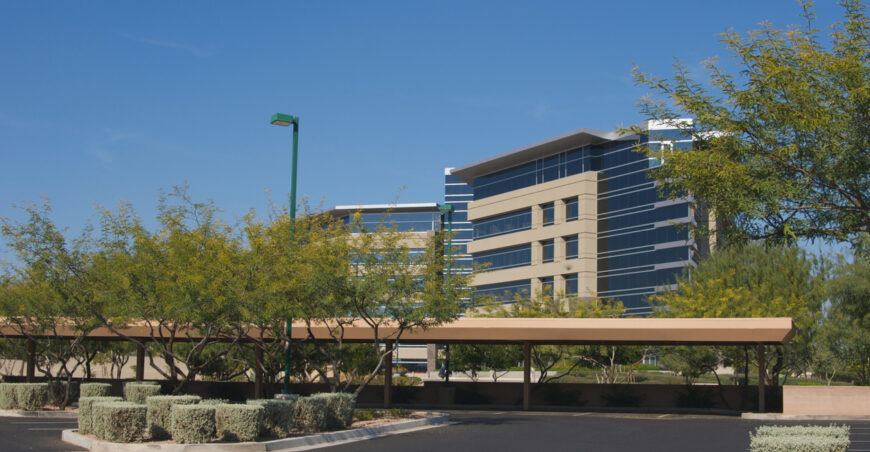
Hospital campuses are reshaping Scottsdale medical office space. Medical office space is entering a new phase. The demand is no longer spread evenly across the city. It is gathering around a short stretch of Loop 101, where three of Arizona’s largest health systems are putting down billions of dollars in new campuses.
In May, Dignity Health announced up to 300,000 square feet of outpatient space at the Arizona Cardinals’ new headquarters site at Scottsdale Road and Loop 101. A few miles west, Mayo Clinic is in the middle of a nearly $1.9 billion, 1.2-million-square-foot expansion of its Phoenix campus. And Banner Health is building a new health center at Hayden Road and Loop 101 while it pursues a full hospital next door.
Here’s the tension. Older medical buildings in parts of Scottsdale are sitting with high vacancy, while space near these new anchors is getting scarcer. Location within Scottsdale now matters as much as being in Scottsdale at all.
Five things every investor, owner, and healthcare tenant should know:
- Hospitals pull doctors with them. Physicians, specialists, imaging, and surgery centers want to be within a short drive of the hospital where they refer and operate.
- The Loop 101 corridor is becoming a healthcare district. Dignity, Mayo, and Banner are all expanding within a few miles of each other.
- New supply is thin. Medical office construction has fallen to its lowest level in years, both nationally and in Phoenix.
- Not all of Scottsdale is winning. Central Scottsdale medical office vacancy is above 26%, so building age and location matter.
- The window is early. Most of these campuses open between 2027 and 2031. The best positioning happens before the ribbon-cuttings, not after.
This article explains what is happening, where the opportunities and risks are, and how to position your property or practice for the next five years.
Current Market Context
Nationally, medical office remains one of the steadiest parts of commercial real estate. CBRE reports that U.S. medical outpatient vacancy fell to 9.7% in Q3 2026, while construction completions dropped to just 264,000 square feet. For context, the quarterly average over the past decade has been 2 to 3 million square feet.
Demand is still growing. Net absorption rose 20% year-over-year to 931,000 square feet, average asking rents rose 1.3% to $25.52 per square foot, and investment sales climbed 13.4% to $3.1 billion. In plain terms, tenants are taking more space at the same time builders are delivering less.
Greater Phoenix follows the same pattern. CBRE puts Phoenix medical office vacancy at 11.9%, with only 28.8% of the 375,000 square feet under construction still available to lease. The market has logged six straight quarters of positive absorption, and vacancy is roughly 700 basis points below traditional office.
The capital markets backdrop is tougher. The 10-year Treasury closed near 5% in late October, its highest level since 2007, after the Federal Reserve’s first rate hike since 2023. Higher borrowing costs make new construction harder to pencil, which further limits future supply of Scottsdale medical office space.
How Hospital Campuses Are Reshaping Scottsdale Medical Office Space
Healthcare follows a simple rule: outpatient care clusters around hospitals. Surgeons want to practice near the operating rooms they use. Specialists want to be close to referral sources. Patients want imaging, labs, and follow-up visits in one convenient area.
When a health system commits hundreds of millions of dollars to a campus, it sends a 20- to 30-year signal about where care will be delivered. Physician groups, ambulatory surgery centers, physical therapy, and diagnostic providers tend to follow within a few miles.
Dignity Health at Scottsdale Road and Loop 101
Dignity’s campus will be its largest outpatient campus. Plans call for two buildings on eight acres, with phase one at 120,000 to 150,000 square feet. Services include a sports medicine institute, Barrow Neurological Institute services, orthopedics, cardiology, imaging, and outpatient surgery. Construction starts in 2027, with an opening expected in 2028 and about 700 jobs.
The site sits just inside Phoenix city limits, but it is functionally part of the North Scottsdale market. It anchors a 217-acre mixed-use development that also includes the Cardinals’ roughly 250,000-square-foot headquarters and training facility, with more than 150 acres planned for restaurants, offices, hotels, and retail.
Mayo Clinic’s Phoenix Campus
Mayo’s “Bold. Forward. Unbound.” expansion adds a new procedural building, 11 operating rooms, and 48 beds, increasing clinical space on the campus by nearly 60%. Completion is slated for 2031. Mayo’s campus already draws patients from across the country, and that national draw supports demand for nearby specialty and support space.
Banner Health at Hayden Road and Loop 101
Banner broke ground in 2025 on a nearly 120,000-square-foot health center in Scottsdale, scheduled for early 2027. Its second phase is a proposed 350,000-square-foot hospital with 106 beds. That hospital phase has faced opposition from HonorHealth and the Scottsdale firefighters’ union. The city’s Airport Advisory Commission recommended denial 5-1 in September 2025, and in January 2026 the Planning Commission continued Banner’s rezoning and use permit cases indefinitely at Banner’s request. As of November 2026, no City Council hearing date has been set.
Even if the hospital phase is delayed, the health center alone adds another major outpatient destination to the corridor. Combined with Dignity and Mayo, North Scottsdale is becoming one of the densest concentrations of healthcare investment in Arizona.
Local Arizona Impact
The demographics behind this investment are strong. Arizona’s Office of Economic Opportunity projects that residents 65 and older will grow from 22% of the state’s population in 2025 to 26% by 2035. Maricopa County is projected to add about 1.28 million residents by 2060.
Scottsdale is already ahead of that curve. Nearly 25% of its residents are 65 or older, one of the highest shares among Arizona cities with more than 100,000 people. Older residents are the heaviest users of outpatient care, and they want it close to home.
Scottsdale also has unusual wealth. Henley & Partners counted about 14,800 millionaires in Scottsdale in 2024, up 125% over a decade. That supports concierge medicine, executive health, cosmetic and elective procedures, and other private-pay services that need high-quality space.
But the local data shows a split market. Kidder Mathews reports Central Scottsdale medical office vacancy at 26.6%, with negative absorption of 56,229 square feet in Q3 2026. Valley-wide direct vacancy sits at 15.2%, with no new medical office buildings delivered for two straight quarters.
The takeaway for Scottsdale medical office space is clear. Older buildings away from the new hospital anchors are losing tenants, while well-located space near Loop 101 is positioned to tighten as these campuses come online.
The effect will reach beyond Scottsdale. Providers priced out of the corridor will look to Tempe, Chandler, and Mesa. Health systems will also keep pushing outpatient care into fast-growing communities like Gilbert, Queen Creek, and San Tan Valley.
National Impact
Across the country, health systems are shifting care out of expensive inpatient hospitals and into outpatient settings. Procedures that once required an overnight stay now happen in surgery centers and specialty clinics. That shift is the main driver of long-term medical office demand.
Medical office has also held its value better than general office. A Yardi Research and CommercialCafe analysis found that 67% of medical office properties traded between 2024 and 2026 appreciated, compared with 52% of general office. Medical office now accounts for 26.2% of all office construction starts, up from 11% five years ago.
Scottsdale medical office space is a clear example of this national trend. The difference is the scale and speed of the investment happening in one corridor at the same time.
Key Risks
- Approval risk. Banner’s hospital phase has been on hold at the Planning Commission since January 2026, with no City Council date set, and faces organized opposition. Investors should not underwrite it as a certainty.
- Timing risk. Dignity opens in 2028 and Mayo’s expansion runs through 2031. Buying too early on future demand means carrying space while you wait.
- Obsolescence risk. Older, poorly located buildings may keep losing tenants to newer space, as Central Scottsdale’s 26.6% vacancy shows.
- Reimbursement risk. Physician groups depend on Medicare and insurance payments. As we covered in our analysis of Medicare cuts and Phoenix medical office, lower reimbursement can squeeze tenants’ ability to pay rent.
- Capital market risk. With the 10-year Treasury near 5%, Cushman & Wakefield reports buyers are asking for 5% to 10% price cuts while sellers are giving up only 3% to 5%. That gap can slow deals and pressure values.
Key Opportunities
- Proximity plays. Existing buildings within a few miles of Dignity, Mayo, and Banner can capture spillover demand from physicians who cannot get into on-campus space.
- Repositioning older buildings. Upgraded HVAC, plumbing, parking, and accessibility can turn a struggling building into competitive medical space at a lower basis than new construction.
- Mixed-use healthcare. The Cardinals’ 150-plus acres of retail, hotel, and office land create room for medical-retail, urgent care, wellness, and specialty clinics.
- Early tenant commitments. Healthcare tenants who lock in long-term leases before 2028 can secure better terms than those who wait until the campuses open.
- Private-pay specialties. Scottsdale’s wealth supports executive health, concierge care, dermatology, cosmetic surgery, and longevity medicine.
The ICRE Perspective
What we are seeing in the field: Healthcare tenants are asking more specific location questions than they did two years ago. It is no longer “Do you have space in Scottsdale?” It is “How far is it from Mayo?” or “What’s near the new Dignity campus?” Drive time to the hospital is becoming a leasing requirement.
What investors are missing: Many buyers look at the average for Scottsdale medical office space and see high vacancy. That average hides two different markets. A 1980s building in Central Scottsdale and a well-located building near Loop 101 are not the same investment, even if they share a ZIP code prefix.
What opportunities are emerging: We see the best risk-adjusted opportunities in existing, well-located buildings that can be upgraded for medical use. They offer a lower basis than new construction, and new construction is getting harder to finance at today’s rates.
What risks are being underestimated: Timing. Investors who pay today for demand that arrives in 2028 or 2031 need enough capital to carry the property in the meantime. We also caution against treating Banner’s hospital as a done deal until approvals are final.
We see the same pattern across the East Valley, where hospital investment in Gilbert, Queen Creek, and San Tan Valley is pulling medical tenants into nearby buildings. North Scottsdale is the same story at a larger scale.
Tenant and Investor Takeaways
- Location within Scottsdale matters most. Evaluate Scottsdale medical office space by its distance to the new hospital anchors, not by the city average.
- Healthcare tenants should act early. Lock in long-term space before 2027–2028 deliveries increase competition near the corridor.
- Investors should favor existing, upgradeable buildings. Limited new supply and high construction costs make existing stock more valuable.
- Underwrite approvals and timing conservatively. Count only committed projects, and plan for the gap before they open.
- Watch the follow-on development. Retail, hotels, and offices on the Cardinals site will shape the corridor’s long-term appeal.
Conclusion
Strategic takeaway: Scottsdale medical office space is no longer one market. Hospital investment along Loop 101 is creating a premium healthcare district, while older buildings elsewhere in the city face real pressure.
Future outlook: As Banner’s health center opens in 2027, Dignity’s campus arrives in 2028, and Mayo completes its expansion by 2031, we expect demand near the corridor to tighten steadily, especially with so little new medical office supply in the pipeline.
Action item: If you own, lease, or plan to buy medical property in North Scottsdale, now is the time to review how your location and building compare to the new campuses, and to plan your next lease or acquisition before these anchors open.
How ICRE Can Help
At ICRE Investment Team, we specialize in helping investors, healthcare providers, and developers navigate the commercial real estate landscape — including medical office development in fast-growing Gilbert. Whether you’re exploring your first medical office investment, evaluating a portfolio opportunity, or looking to understand how healthcare campuses fit into a broader CRE strategy, our team has the market knowledge and relationships to help you move forward with confidence.
Healthcare real estate is not a passive play. It requires the right guidance, the right location analysis, and the right understanding of tenant needs. That’s exactly what we bring to every transaction.
Ready to stay ahead of the market? Join thousands of investors and CRE professionals who get our latest insights, market updates, and investment opportunities delivered straight to their inbox.
Sign up for the ICRE Newsletter here →
Don’t miss the next opportunity — subscribe today and let the ICRE Investment Team be your guide in one of the most resilient and fast-growing sectors in commercial real estate.
Related reading: Medical Office Development in Gilbert, AZ Poised for Growth