
Medical land development is no longer a niche strategy; it’s becoming a core opportunity for healthcare providers and investors alike. In today’s commercial real estate landscape, one sector continues to quietly outperform the rest – healthcare. More specifically, medical land development has emerged as a powerful opportunity for owner-users looking to control costs, build equity, and create long-term value.
While traditional office and retail sectors navigate uncertainty, medical real estate is being driven by something far more reliable: demand for care. And that demand isn’t slowing down.
Why Medical Land Development Is Gaining Momentum
Healthcare is shifting. Patients want convenience, accessibility, and faster service. Providers are responding by moving away from hospital campuses and into outpatient settings closer to where people live and work.
According to PwC’s Medical Office Outlook, healthcare real estate is positioned to outperform in the coming years due to strong demographic trends and sustained outpatient demand.
This shift is creating a surge in demand for new medical space and that starts with land. At the same time, limited new construction and rising costs are tightening supply. That imbalance is opening the door for developers and owner-users to step in and create value from the ground up.
For a deeper look at how healthcare real estate is evolving, check out this article: https://investingincre.com/2024/09/13/how-medical-real-estate-is-evolvin
The Owner-User Advantage
For physicians and healthcare groups, owning real estate is no longer just an investment, it’s a strategy.
Instead of leasing space and absorbing rising rental costs, owner-users can:
- Control their occupancy costs
- Build equity in a hard asset
- Benefit from appreciation
- Capture long-term income potential
More importantly, ownership allows providers to design space around their operations—whether it’s an ambulatory surgery center (ASC), imaging facility, or specialty clinic.
This is especially relevant as more procedures move to outpatient settings. Data shows outpatient revenue has surged significantly in recent years, driven by advancements in technology and patient preference. If you’re considering expansion, this breakdown is a great resource: https://investingincre.com/2024/09/06/expanding-medical-practices/
Why Land Is the Real Opportunity
Most investors focus on stabilized medical office buildings. But the real upside is often found earlier in the lifecycle at the land stage.
Here’s why:
1. Lower Basis, Higher Upside
Buying land before vertical development allows owner-users to enter at a lower cost basis. As entitlements, infrastructure, and vertical construction are completed, value increases significantly.
2. Control Over the Development
Owner-users can control everything from site layout to building specifications. That means designing efficient workflows, optimizing patient flow, and maximizing revenue-generating space.
3. Strategic Location Positioning
Healthcare is hyper-local. Being positioned near rooftops, major corridors, and hospitals creates built-in demand.
Many successful projects are strategically placed in high-growth suburban markets where populations are expanding, but healthcare infrastructure is still catching up. Understanding location strategy is critical and it matters.
The Shift Toward Outpatient Care
One of the biggest drivers behind this trend is the migration of care away from hospitals. Procedures that once required inpatient stays are now being performed in outpatient settings like ASCs and specialty clinics.
This shift is not just operational, it’s financial. Outpatient facilities are often more efficient and cost-effective, making them attractive for both providers and patients. As a result, demand for medical office buildings and outpatient facilities continues to grow, with occupancy rates reaching strong levels across major markets.
Stability in an Uncertain Market
One of the reasons medical real estate stands out is its resilience.
Unlike traditional office space, healthcare demand does not fluctuate with economic cycles. People still need care regardless of market conditions.
As noted in Why Medical Office Buildings Remain Resilient in 2025, medical office properties benefit from:
- Essential-service demand
- Long-term tenant stability
- Limited supply of new development
For owner-users, this translates into predictable operations and long-term security.
Phoenix: A National Hub for Healthcare Expansion
Across the Valley, we’re seeing firsthand why Phoenix has become one of the fastest-growing healthcare markets in the U.S.
Rapid population growth, strong demographics, and expanding infrastructure are driving demand for new medical developments at an accelerated pace.
I recently highlighted several of the premier medical properties and developments we’re actively working on across the Valley, showcasing how healthcare groups are expanding into strategic locations to meet this demand:
Terraza Medical Village
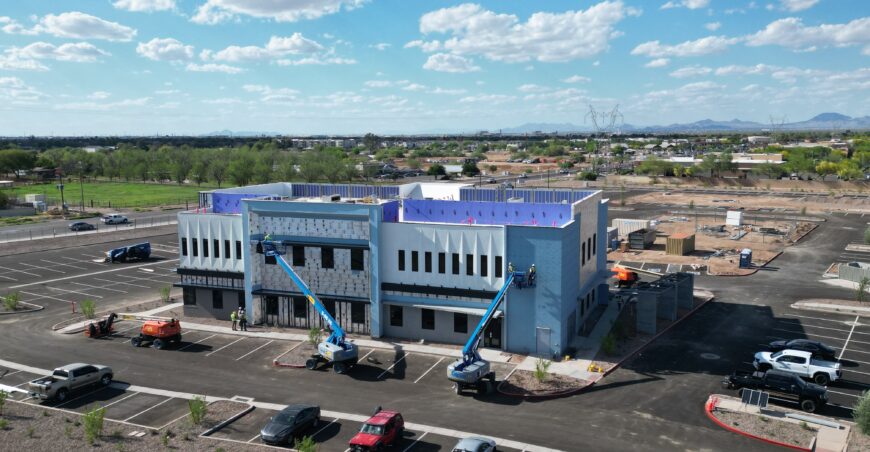
Terraza Medical Village demonstrate how medical land development is being executed at scale—bringing together providers, investors, and developers to create fully integrated healthcare ecosystems. Terraza Medical Village is a real time case study of how demand is translating into execution-now visibly taking shape on site in San Tan Valley, that momentum is already translating into vertical construction. The project is already demonstrating strong demand from healthcare users, with Buildings 4 and 5 fully pre-leased prior to delivery—reinforcing the depth of unmet need in the Southeast Valley. With infrastructure in place and construction underway, Terraza is positioned to deliver a purpose-built environment for modern outpatient care, aligned with the continued shift toward decentralized healthcare services. Availability remains in Building 3, offering a limited opportunity for providers looking to establish a presence in one of the fastest-growing corridors in Greater Phoenix. For those tracking where medical development is actually materializing—not just being planned—Terraza is a real-time case study of how demand is translating into execution.
Partnerships Are Fueling Growth
Another trend accelerating medical land development is collaboration.
Healthcare systems, private equity groups, and developers are increasingly partnering to share costs and scale projects as stated by Nexcore Group.
These partnerships allow providers to:
- Access better sites
- Reduce upfront capital requirements
- Expand more efficiently
In many cases, physicians are stepping into ownership alongside developers—creating alignment and long-term upside.
Why This Matters Right Now
Timing plays a critical role in real estate and right now, several factors are aligning:
- Population growth in key markets
- Aging demographics increasing healthcare demand
- Limited supply of new medical space
- Continued shift to outpatient care
- Rising lease rates
At the same time, many healthcare providers are rethinking their long-term real estate strategy. Instead of leasing indefinitely, they’re looking to own, control, and invest.
That’s where medical land development becomes a powerful tool.
Where This Is Headed
Medical land development is no longer a niche strategy; it’s becoming a core opportunity for healthcare providers and investors alike. For owner-users, it offers something rare in today’s market: control, stability, and long-term upside. Those who get in early at the land stage are positioning themselves not just as tenants, but as owners of critical healthcare infrastructure in growing communities.
At ICRE Investment Team, we specialize in identifying and structuring medical real estate opportunities from land acquisition and development to leasing and investment sales. Our focus is helping healthcare providers and investors create long-term value through strategic real estate decisions.
If you’re exploring medical land development or looking to position your practice for long-term growth, we’d love to connect.
Stay ahead of the market and get insights like this delivered directly to your inbox:
Sign up for our newsletter here.