

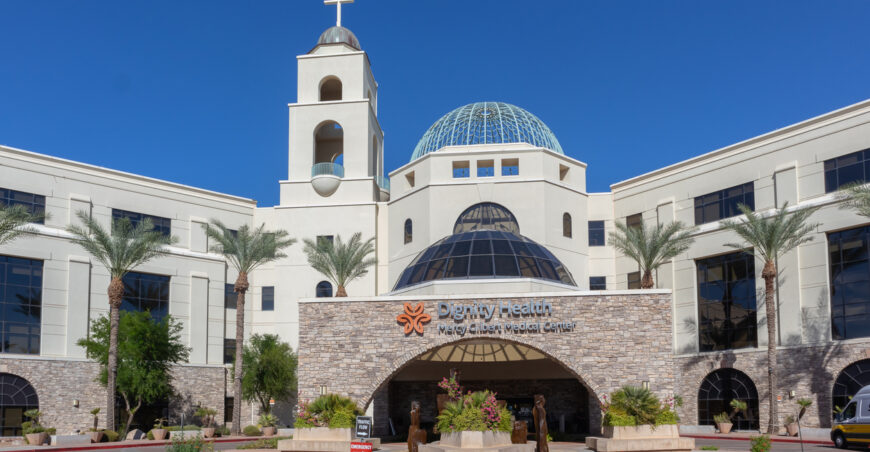
If you’re evaluating medical office opportunities in Gilbert, Arizona—whether as a healthcare provider, investor, or developer—the data is pointing to a clear and compelling conclusion:
The Mercy Gilbert trade area is structurally undersupplied—and the opportunity is measurable.
A recent Healthcare Market Gap Analysis of the Mercy Gilbert trade area—leveraging data from Esri Business Analyst, U.S. Census (ACS), and verified healthcare business datasets—confirms what many in the market are beginning to see in real time: demand has outpaced supply, creating a strategic window for medical office development.
A Quantifiable Supply Gap in a High-Growth Trade Area
Within a 5-mile radius of Mercy Gilbert Medical Center:
- Population: 302,000+ residents
- Existing healthcare facilities: ~493 locations
- Expected facilities (based on regional density): ~639 locations
- Net shortage: ~146 facilities (~23% undersupplied)
This analysis is based on population-normalized benchmarking against the broader East Valley healthcare ecosystem, providing a realistic measure of how many providers should exist in this market.
From a real estate perspective, this translates into:
Approximately 100,000 to 150,000 square feet of unmet medical office demand
That level of unmet demand is not incremental—it reflects a structural imbalance between population growth and healthcare infrastructure.
Why Mercy Gilbert Is One of Phoenix’s Strongest Healthcare Submarkets
Not all growth markets create meaningful opportunity. What makes the Mercy Gilbert trade area stand out is the alignment of demographics, income, and healthcare demand drivers.
Key fundamentals include:
- Average household income of approximately $142,000, with multiple submarkets exceeding $225,000
- Continued population growth across Gilbert and Queen Creek
- A major hospital anchor driving patient volume and referral patterns
- Ongoing shift toward outpatient and specialty care delivery
This is not just a growing market—it is a high-income, high-demand healthcare corridor capable of supporting long-term medical office absorption.
The Most Important Insight: Where Demand Is Underserved
One of the most valuable findings from the gap analysis is not just identifying a shortage—but pinpointing where that shortage exists geographically.
The data shows a clear pattern:
- Healthcare providers are heavily concentrated north of the hospital
- The southern and southeastern portions of the trade area remain underpenetrated
- The highest-income population clusters are located within these underserved areas
The most actionable corridor:
Val Vista Drive to Higley Road, south of Pecos Road
This creates a compelling dynamic:
High-income households + limited healthcare supply = immediate demand imbalance
For healthcare operators and investors, this represents one of the clearest indicators of where expansion can be both strategic and successful.
Specialty Healthcare Is Driving the Opportunity
This is not a broad-based shortage across all healthcare categories.
The gap is concentrated in specialty and ancillary services, including:
- Cardiology
- Women’s health
- Orthopedics
- Dental specialty services
- Home health
In several cases, the analysis identified true “void” categories—segments where there is little to no local presence.
At the same time:
- Primary care is closer to equilibrium
- Retail healthcare (pharmacy-based services) is already well represented
Translation:
The strongest opportunity exists in specialty outpatient care, where demand is established but supply has not yet caught up.
Rethinking Location Strategy: Beyond the Hospital Core
A common assumption in healthcare real estate is that proximity to the hospital is the primary driver of success.
However, the data suggests a more refined approach:
- The immediate hospital area is already densely built and highly competitive
- Provider concentration is highest within the core medical corridor
- The strongest opportunity exists in the 1–3 mile ring south and southeast of the hospital
This positioning allows providers to:
- Maintain proximity to referral networks
- Avoid oversaturated submarkets
- Capture demand in rapidly growing residential areas
This “second-ring” strategy reflects a more balanced and scalable approach to site selection.
What Should Be Built: Aligning Product with Market Demand
The gap analysis provides direction not only on where to develop—but also what type of product aligns with demand.
Recommended development profile:
- 4,000–8,000 square foot suites
- Multi-tenant outpatient-focused buildings
- Flexible layouts designed for specialty providers
- Infrastructure capable of supporting surgical or advanced care
These recommendations are derived directly from the supply-demand imbalance and specialty gaps identified in the analysis.
They align with:
- Physician group expansion strategies
- Private equity-backed healthcare platforms
- The continued migration toward outpatient care delivery
A Data-Driven Opportunity Already in Motion
The ICRE Investment Team is actively positioned within this trade area, controlling approximately 23 acres of medical-zoned land near Mercy Gilbert Medical Center.
Current opportunities include:
- East Valley Healthcare Anchor
- Mercy Gateway Medical Campus
- Premier Medical Development Q2 2026
Each of these sites is strategically positioned within the submarkets identified as underserved, aligning directly with the findings of the gap analysis.
Why This Window Exists—and Why It Won’t Last
Markets do not remain undersupplied indefinitely.
As providers expand and developers respond to demand:
- New supply enters the market
- Competition increases
- Early positioning advantages diminish
Today, the Mercy Gilbert trade area represents a timing advantage:
Demand is already proven—but supply has not fully responded.
That is where the opportunity exists.
One of the Last Remaining Medical Land Opportunities Near Mercy Gilbert Hospital
For groups looking to move early in this market, we control over 23 acres of medical-zoned land directly adjacent to Mercy Gilbert Medical Center—one of the last remaining opportunities to develop at scale in this corridor. These sites are ideal for owner-users, ambulatory surgery centers, and institutional developers looking to establish a presence in a high-demand, supply-constrained trade area. Opportunities like this—proximity to a major hospital, strong demographics, and limited competing land—are becoming increasingly rare in the Phoenix MSA. If expansion or development is on your radar, this is a strategic entry point worth serious consideration.
Download the Full Mercy Gilbert Healthcare Gap Analysis
This article highlights the key findings—but the full report provides deeper insight into:
- Geographic distribution of healthcare supply and demand
- Specialty-level gaps and true “void” categories
- Income-driven demand patterns across the trade area
- Data-driven site selection and medical office development recommendations
Download the full Mercy Gilbert Healthcare Gap Analysis to explore the data behind the opportunity and gain a deeper understanding of where the market is heading.

Work with a Healthcare Real Estate Specialist
The ICRE Investment Team specializes in:
- Medical office development
- Healthcare investment sales
- Physician and operator representation
If you’re evaluating expansion, investment, or development opportunities in Gilbert or the greater Phoenix market:
Let’s connect. Stay ahead. Stay informed.