

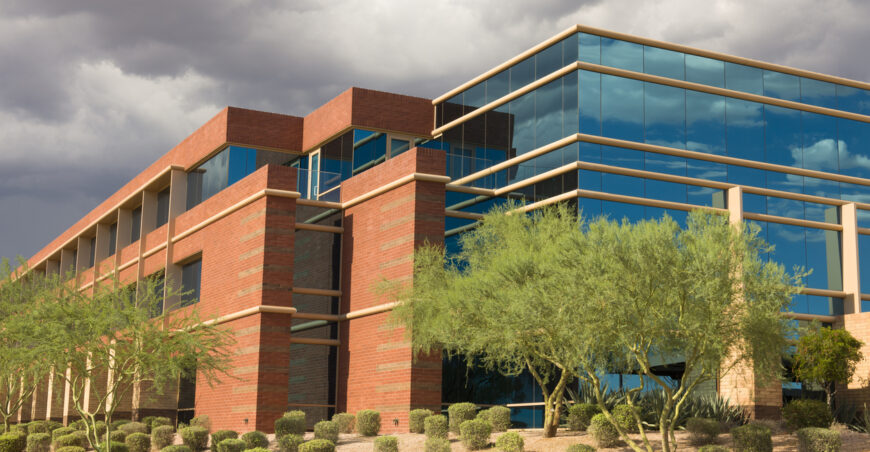
While much of commercial real estate spent the last two years wrestling with high interest rates, refinancing pressure, and uneven office demand, one asset class quietly outperformed nearly everything else: medical office. Heading into the second half of 2026, the Arizona medical office market stands out as one of the most defensive and durable opportunities in commercial real estate — locally and nationally.
Three forces are driving this: an aging population that needs more care every year, a national pullback in new construction that is tightening supply, and Arizona’s nation-leading population growth. The result is rising rents, steady occupancy, and an investment thesis that does not depend on a perfect economy to work.
Here are the five takeaways this article unpacks:
- Medical office is now widely regarded as the most defensive asset class in U.S. commercial real estate.
- New medical office construction is falling to a decade low, tightening supply just as demand climbs.
- Greater Phoenix posted positive net absorption and 6.1% year-over-year rent growth at mid-year 2026.
- Arizona’s aging population and physician shortage create structural, long-term demand.
- For investors, owners, and healthcare tenants, the window to act is now — before supply tightens further.
Defensive does not mean boring. In commercial real estate, a defensive asset is one that holds value and produces income across economic cycles — the kind of property that keeps performing when the broader market gets choppy. By that definition, the Arizona medical office market has become one of the most attractive places to put capital in 2026.
The reason is simple. People do not stop going to the doctor during a downturn. Healthcare demand is tied to demographics, not the business cycle, and the demographics could hardly be more favorable. That stability is exactly why national investors are reallocating toward medical office — and why Arizona, with its explosive population growth, sits at the center of the story.
Current Market Context
The macro backdrop for commercial real estate remains demanding. Roughly $539 billion of CRE debt matures in 2026 — well above the 20-year average of about $350 billion — and office continues to carry the heaviest distress, with CMBS office delinquency topping 12% in early 2026. Refinancing at today’s rates remains painful for owners who borrowed in the low-rate years.
Against that pressure, capital is rotating toward asset classes with reliable income. Medical office has emerged as a primary beneficiary. According to CBRE, medical office building (MOB) occupancy is holding at roughly 92% nationally, with select metros in the mid-90s, and the sector is positioned to outperform in 2026 on the strength of income durability and demographic tailwinds.
The supply side is what makes this moment unusual. MOB construction completions are projected to fall about 26% in 2026 — the lowest level in more than a decade. Less new product means existing, well-located buildings face less competition, supporting both occupancy and rent growth.
Main Analysis: Why Medical Office Is Outperforming
Three structural drivers explain medical office’s defensive strength.
Demographics are destiny. Per PwC and ULI’s Emerging Trends in Real Estate, the U.S. population aged 75 and older is growing by more than one million people per year — roughly triple the rate of the past 40 years. Older patients consume far more healthcare than any other group, and that demand lands largely in outpatient settings: physician offices, imaging centers, surgery centers, and specialty clinics. This is a multi-decade tailwind, not a passing trend.
Care is moving out of the hospital. Health systems continue shifting procedures to lower-cost outpatient locations closer to where patients live. That migration favors well-placed medical office buildings — and increasingly drives the conversion of obsolete office and retail space into medical use. For owners of aging traditional office, medical conversion is becoming a genuine repositioning strategy rather than a last resort.
Supply discipline. With construction completions dropping to a decade low and new development economics squeezed by elevated construction costs and financing, the supply pipeline is thin. Tight supply plus durable demand is the classic recipe for rent growth and cap rate stability — and analysts expect cap rates for medical office to hold steady or compress slightly in 2026, especially for buildings with long-term leases to credit tenants.
Local Arizona Impact
Nowhere does this national thesis translate more cleanly than in Arizona.
At the mid-year 2026 point, the Greater Phoenix medical office market posted positive momentum. Net absorption in the second quarter totaled 206,449 square feet, bringing year-to-date net absorption to 173,331 square feet. Average asking rents rose to $23.05 per square foot — a 6.1% increase year-over-year — while metro vacancy sat at 13.1%, a level that is steadily tightening as new product leases up.
Submarket performance underscores how location-specific this market is. Arrowhead led the metro with 111,656 square feet of net absorption in the quarter, followed by Glendale at 44,699 square feet. On the tight end, the Airport Area registered effectively zero vacancy and Downtown North sat at just 2.9% — evidence that well-positioned medical space in Greater Phoenix is in genuinely short supply.
The demand engine behind these numbers is Arizona’s demographics. The Phoenix metro share of residents aged 65 and older climbed from 12.3% to 16.6% between 2010 and 2020, and the region added 10,000 to 20,000 more residents for nearly every age between 55 and 78 compared with a decade earlier. Maricopa County has been among the fastest-growing counties in the nation for years, and growth in Pinal County communities like San Tan Valley and Queen Creek is pushing demand into newer suburban submarkets.
There is also a supply-of-care gap that compounds the real estate opportunity. Arizona currently meets only about 35.4% of its primary care physician needs and would require an estimated 493 additional full-time primary care physicians to eliminate its designated shortage areas. More residents, more older residents, and too few providers all point the same direction: sustained demand for medical space across Phoenix, Scottsdale, Mesa, Chandler, Gilbert, Tempe, Queen Creek, and San Tan Valley.
National Impact
Arizona’s story is a sharper version of a national one. Across the country, medical office is being repriced as a core, defensive holding rather than a niche alternative. Institutional investors who spent the 2010s chasing industrial and multifamily are now allocating to healthcare real estate for its income stability and recession resistance.
Two national dynamics matter for Arizona owners and investors. First, capital competition for quality medical office is intensifying, which supports valuations even as financing stays expensive. Second, AI adoption by healthcare providers is accelerating, helping practices manage patient volume and optimize how they use space — a trend that may modestly improve space efficiency over time but does little to offset the demographic wave. The net effect nationally is the same conclusion Arizona’s data already shows: durable demand, constrained supply, and pricing power for owners.
Key Risks
No asset class is risk-free, and medical office carries its own.
Tenant credit and reimbursement risk are real — independent practices can be financially fragile, and changes to healthcare reimbursement can pressure tenants. Lease structure matters enormously: a building leased to a strong health-system or credit tenant on a long term is a very different asset than one filled with small, short-term practices. Construction and tenant-improvement costs remain elevated, which can make build-to-suit and conversion projects more expensive to underwrite. And while Phoenix vacancy is tightening, 13.1% metro-wide vacancy means submarket and building selection still separate winners from laggards. Finally, the broader financing environment — high rates and the 2026 maturity wall — still affects medical office acquisitions, even if the sector is more resilient than office or hotels.
Key Opportunities
For those positioned correctly, the opportunities are substantial.
Investors can target well-located, credit-tenant medical buildings in high-growth Phoenix submarkets before supply tightens further and cap rates compress. Value-add buyers can look at conversion plays — obsolete office or retail repositioned into medical use in underserved, fast-growing suburbs like Queen Creek and San Tan Valley. Owners of existing medical office have pricing power in a rising-rent, low-supply environment and should be proactive on renewals and repositioning. Healthcare tenants and operators, facing a thinning pipeline of new space, benefit from securing locations now and from build-to-suit relationships in growth corridors where demand clearly outruns current supply.
The ICRE Perspective
Here is what we are seeing in the field that the headline numbers do not fully capture.
The Greater Phoenix metro vacancy figure of 13.1% is misleading on its own. The reality is a tale of two markets: genuinely scarce, high-demand space in established and infill submarkets (the Airport Area and Downtown North are effectively full), and softer pockets in older, less functional buildings. Investors who treat “Phoenix medical office” as one market will misprice both ends.
What investors are missing is the conversion opportunity. With new construction completions falling to a decade low and traditional office still under pressure, the most overlooked play in Arizona right now is repositioning the right office or retail box into modern medical or mixed-use healthcare space in a growth corridor. The demographics guarantee the demand; the question is execution — location analysis, tenant fit, and parking and infrastructure that medical use requires.
The risk we think is underestimated is tenant quality dressed up as yield. In a market this attractive, it is easy to chase a slightly higher cap rate into a building full of weak, short-term tenants. The durable returns are in credit-tenant, long-term-leased assets — and that discipline matters more, not less, when a sector is popular.
Investor Takeaways
- Medical office is defensive by design. Demand is tied to demographics, not the economic cycle, making it one of the most resilient CRE asset classes in 2026.
- Supply is tightening. With national construction completions falling roughly 26% to a decade low, well-located existing buildings gain pricing power.
- Arizona is a top market. Phoenix posted positive net absorption and 6.1% year-over-year rent growth at mid-year 2026, backed by nation-leading population and aging trends.
- Submarket selection is everything. Metro-wide vacancy of 13.1% hides near-zero vacancy in the best locations — buy the location, not the average.
- Underwrite tenant credit, not just yield. The durable returns are in long-term leases to strong tenants; conversions in high-growth suburbs are the most overlooked opportunity.
Conclusion
The strategic takeaway is straightforward: medical office has graduated from a specialty play to a core defensive holding, and Arizona is one of the best places in the country to own it. The future outlook is favorable — demographics, supply discipline, and a persistent physician shortage all point to sustained demand through the rest of the decade. The action item is to move before the window narrows: identify credit-tenant assets and conversion opportunities in high-growth Phoenix submarkets now, while supply is still adjusting and pricing power is shifting toward owners.
In a commercial real estate landscape full of uncertainty, medical office offers something rare — a thesis that works even when the economy does not cooperate. Arizona’s growth makes that thesis stronger here than almost anywhere else.
How ICRE Can Help
At ICRE Investment Team, we specialize in helping investors, healthcare providers, and developers navigate the commercial real estate landscape — including the growing world of mixed-use healthcare assets. Whether you’re exploring your first medical office investment, evaluating a portfolio opportunity, or looking to understand how healthcare campuses fit into a broader CRE strategy, our team has the market knowledge and relationships to help you move forward with confidence.
Healthcare real estate is not a passive play. It requires the right guidance, the right location analysis, and the right understanding of tenant needs. That’s exactly what we bring to every transaction.
Ready to stay ahead of the market? Join thousands of investors and CRE professionals who get our latest insights, market updates, and investment opportunities delivered straight to their inbox.
Sign up for the ICRE Newsletter here →
Don’t miss the next opportunity — subscribe today and let the ICRE Investment Team be your guide in one of the most resilient and fast-growing sectors in commercial real estate.
Related reading: The Growing Demand for Mixed-Use Commercial Real Estate Healthcare Campuses