

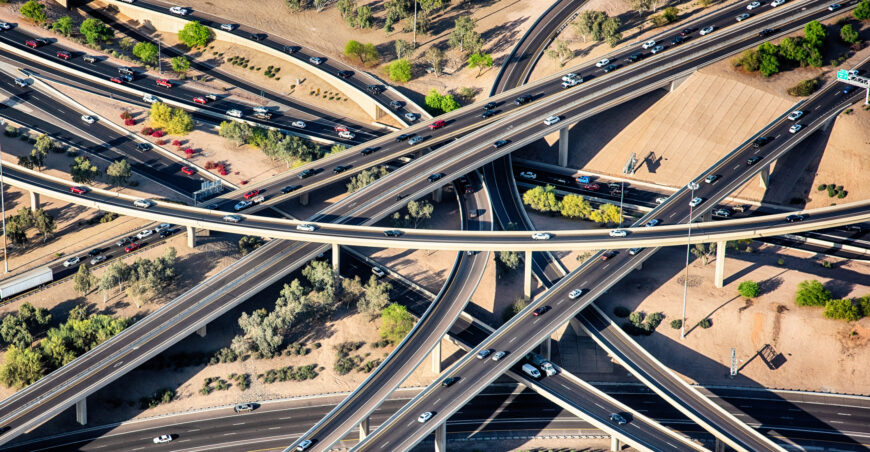
Across Arizona, infrastructure spending is playing a central role in guiding commercial real estate decisions. From transportation upgrades to transit expansions, planned improvements in public infrastructure affect where companies locate, how users access properties, and where future growth will occur. In a fast-growing state like Arizona, these investments are influencing commercial demand in tangible ways that matter to tenants, developers, and investors alike, reinforcing trends already discussed in Commercial Real Estate Investors Are Eyeing Arizona.
In the broadest sense, public infrastructure spending impacts commercial real estate through accessibility, connectivity, and quality of life. Investors and users both care about how easily employees, customers, and goods can get to a property. When roads, transit, utilities, and public services are stronger, properties become more valuable because businesses can operate more efficiently, and people are more willing to live and work nearby, a relationship explored further in Infrastructure Development and Commercial Real Estate Prices
Transportation improvements and industrial demand
One of the clearest examples of infrastructure shaping commercial markets is the growth of transportation projects aimed at supporting regional mobility. Recent planning and construction around key freeway corridors, including improvements to Interstate 10 and expansions such as the Loop 101 interchange projects, aim to reduce congestion and improve freight reliability. These changes influence where logistics and industrial users want to locate because shorter and more predictable travel times lower operating costs and expand labor sheds for employers. For example, construction on the Interstate 10 corridor between Chandler and Casa Grande is underway and expected to be completed in 2026, enhancing a vital artery for goods movement in and out of the Phoenix region.
At the same time, Loop 101 improvements, including direct high-occupancy vehicle lane connections and interchange upgrades, are planned through 2027. These projects aim to improve movement between major employment and residential centers, which also impacts where industrial and service-oriented businesses choose to locate.
These types of transportation investments matter for commercial real estate because industrial firms and distribution users are highly sensitive to travel time and variability. When infrastructure makes delivery routes faster and more reliable, vacancies can tighten, and rents can rise in well-connected submarkets, particularly as broader demand drivers outlined in What’s Driving Arizona’s Commercial Real Estate Market.
Infrastructure and broader market capacity
Growth in Arizona continues to outpace infrastructure in some parts of the state. A recent industry analysis highlighted that the Phoenix metropolitan area is projected to absorb 1.1 million new residents over the next 15 years, placing pressure on existing infrastructure. Limitations in power, water, and transportation systems are already influencing where institutional capital is deployed and how development models are structured.
This dynamic shows that infrastructure constraints can be just as influential as infrastructure investment. When services and utilities lag growth, it can deter development and delay new commercial projects, especially in fast-expanding markets. For example, access to reliable power and water infrastructure has become a critical factor for data centers, advanced manufacturing facilities, and other capital-intensive uses that require robust utilities to operate efficiently.
Transit expansions and urban commercial demand
Public transit investments can also reshape commercial real estate demand, particularly for retail, office, and mixed-use developments. The Valley Metro Rail system in the Phoenix area recently opened its South-Central extension, expanding service to new neighborhoods and increasing connectivity between downtown and southern Phoenix.
While light rail does not directly drive demand in every sector, transit improvements often support denser mixed-use growth by improving employee and customer access to retail corridors, medical clinics, and offices. Especially in urban cores, proximity to reliable transit can enhance foot traffic and make properties more attractive to tenants who view access as a quality-of-life benefit for staff – an important consideration also emphasized in Location in Healthcare Real Estate Investments
Commercial developments near transit also benefit from increased visibility and accessibility, factors that often translate into stronger long-term occupancy and rent performance.
Retail, office, and amenities tied to infrastructure
Beyond transportation and utilities, broader infrastructure spending such as streetscape upgrades, public parks, and community facilities plays a supporting role in shaping commercial demand. Areas with improved public amenities attract more foot traffic, help retain employees, and make clusters of shops, services, and offices more vibrant.
Local governments often pair infrastructure spending with economic development strategies to support commercial corridors. These investments can catalyze redevelopment or reposition older properties, creating new mixed-use environments that attract retailers, hospitality businesses, and professional office tenants, echoing themes outlined in Why Commercial Developments Are Beneficial for Economies
Planning and predictability matter for investors and developers
For investors and developers, the degree of planning and certainty around public infrastructure spending is a critical factor in underwriting and risk assessment. Confirmed projects with secured funding and permits provide a clearer timeline for when improvements will be delivered, allowing developers to align their construction schedules accordingly.
Strategic planning documents, such as the Five-Year Transportation Facilities Construction Program approved by the Arizona State Transportation Board, outline billions in pavement, bridge, and highway improvements statewide, helping commercial stakeholders anticipate where investment will occur. Regional outlooks like the Scottsdale Economic Forecast Conference 2026: Arizona’s Commercial Real Estate Outlook reinforce how infrastructure planning supports long-term underwriting and capital allocation decisions.
When infrastructure upgrades are already in government capital plans, commercial real estate professionals can use that information to assess future demand for space, justify valuation assumptions, and educate their clients. Underwriting future rents and absorption becomes far easier when there is a clear expectation of improved access, connectivity, and utility capacity.
How infrastructure spending influences real estate fundamentals
Infrastructure spending rarely operates in isolation. It often acts as a catalyst that accelerates trends already underway in population growth, employment, and household formation. As infrastructure improves, we typically observe a pattern:
- Enhanced access attracts new businesses and expands job opportunities.
- Rising employment supports demand for services, retail, and medical visits.
- Increased demand for commercial space tightens vacancies and can support rent growth.
- Properties in well-served locations command stronger investor interest.
Understanding this sequence helps owners and investors distinguish between temporary market shifts and long-term value drivers.
At the ICRE Investment Team, we look at infrastructure spending not as an abstract budget number, but as a real driver of commercial activity. We follow funded projects, understand their timelines, and connect them to site selection fundamentals that matter to tenants, investors, and end users. Whether you are evaluating industrial land distribution, office space for expanding teams, or neighborhood retail that depends on daily foot traffic, infrastructure improvements are a foundational part of the story.
If you want a detailed, local perspective on how current infrastructure investments may shape demand for your property or target submarket in Arizona, the ICRE Investment Team is ready to help with data-driven insights and strategic guidance tailored to your goals.