

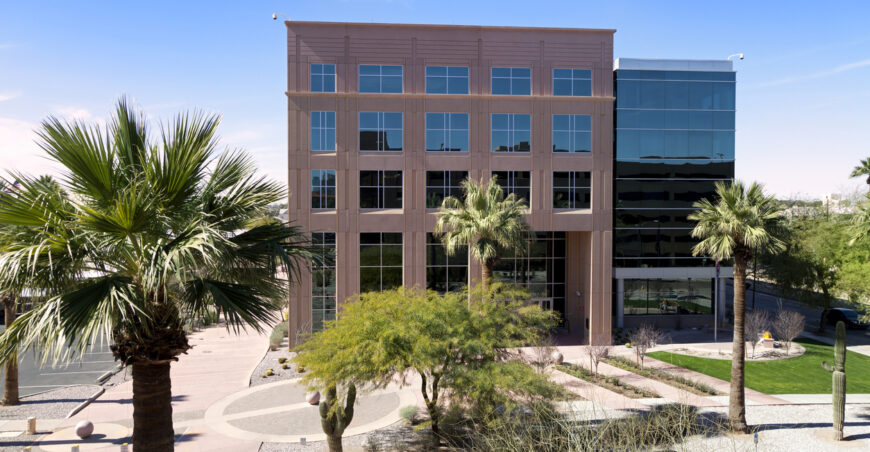
Phoenix office market trends have been one of the most misread stories in Arizona commercial real estate. For three years, headlines fixated on a single scary number — a vacancy rate above 23% — and concluded the sector was broken. That reading misses what is actually happening on the ground. Beneath the surface, the Valley office market is quietly repairing itself, and the mechanism is not a wave of new tenants. It is a wave of obsolete buildings being pulled from inventory and repositioned into alternative uses.
The evidence is already in the numbers. Valley office vacancy fell for a third straight quarter to 23.4% in Q2 2026, on 167,319 square feet of positive net absorption, and no speculative office broke ground during the quarter — so no new empty space is being added even as older space leaves. Nationally, office-to-residential conversions hit a record 90,300 units in 2026, up 28% year over year, a structural trend Phoenix is now firmly riding. The takeaway for investors is that the real opportunity sits in well-located, functional office and in the conversion candidates trading below replacement cost.
This distinction matters because it changes how owners, investors, and tenants should act. If vacancy were falling purely on new demand, the playbook would be simple: wait for the tide to lift every building. But when the market heals by subtraction, the winners and losers separate sharply. Good buildings tighten. Bad buildings get bought, gutted, and converted. Sitting in the middle is the most dangerous place to be.
Current Market Context
The Greater Phoenix office market posted 167,319 square feet of positive net absorption in the second quarter of 2026, its third consecutive quarter of positive absorption. Overall vacancy edged down to 23.4%, roughly 200 basis points lower than a year earlier. Sublease availability — a key stress gauge during the remote-work shakeout — has fallen to about 4.2%, continuing a steady decline from 2025.
Rents are firming, though gently. Average asking rents rose about 2.2% year over year, growth that still trails inflation. Just as important is what is not happening: no speculative office projects broke ground in Q2 2026. New construction is now largely limited to build-to-suit headquarters projects, which means landlords are not competing against a flood of shiny new empty space.
Put those pieces together and a clear picture emerges. Supply is shrinking from two directions at once — no new speculative buildings coming in, and older buildings leaving through conversion. Even flat demand looks like progress against that backdrop.
Phoenix Office Market Trends: Why Vacancy Is Finally Falling in 2026
The central question is simple: is vacancy falling because more companies are leasing space, or because bad space is disappearing? The honest answer is that it is mostly the second one, and that is a healthier story than it first sounds.
Consider the transactions driving the numbers. In Scottsdale, Diversified Partners acquired the Lakefront at Scottsdale for redevelopment, and Finish Line Auto Storage bought a vacant Scottsdale Perimeter office building for repositioning. These are not lease deals. They are inventory-reduction deals. Every square foot pulled out for redevelopment is a square foot that stops dragging down the vacancy rate — permanently.
This is a national pattern that Phoenix is now firmly part of. Across the country, office-to-residential conversions reached a record 90,300 units in 2026, up 28% from the prior year, and office buildings now make up nearly half of all adaptive reuse projects nationwide. With national office vacancy still hovering near 20%, developers have concluded that the fastest cure for empty offices is to stop treating them as offices.
Phoenix has specific tailwinds that make conversion work here. The Valley faces a persistent housing shortage and a shortage of developable infill land, so repurposing a well-located but functionally obsolete office building into apartments or industrial-adjacent uses can pencil where ground-up development cannot. The result is a market that is bifurcating — a term the CBRE 2026 outlook uses to describe how modern, amenitized, well-located office is thriving while dated commodity space struggles or exits entirely.
Local Arizona Impact
The engine underneath all of this is population. Metro Phoenix reached 5,228,938 residents as of July 2025, adding 59,065 people in a single year — the fourth-largest numeric growth of any U.S. metro. At a 1.14% growth rate, Phoenix expanded more than twice as fast as the national average of 0.52%. People need places to live and work, and that demand is precisely what makes office conversions viable.
Scottsdale is the clearest laboratory for these Phoenix office market trends. Its combination of high land values, limited developable parcels, and strong residential demand makes repositioning older office assets more profitable than letting them sit vacant. The Lakefront and Perimeter deals are early examples of what is likely to become a steady pipeline across Scottsdale, Tempe, and the Camelback Corridor.
The submarket picture is uneven, and that is the point. Well-located space in Scottsdale, North Tempe, and the Camelback Corridor is tightening as functional inventory shrinks. Older, car-dependent product in fringe submarkets remains soft and is the most likely conversion fodder. For owners, the message is that location and functionality now matter far more than the headline vacancy rate suggests.
Looking forward, continued in-migration and a durable housing shortage point to more conversions, not fewer. As long as Phoenix keeps adding tens of thousands of residents a year and infill land stays scarce, obsolete office will keep finding a second life — and the office vacancy rate should keep grinding lower as a result.
National Impact
Phoenix is not an outlier; it is a leading indicator. The record 90,300 conversion units nationwide in 2026 show that adaptive reuse has hit critical mass as a mainstream strategy rather than a niche experiment. Markets from Denver to Philadelphia to St. Louis more than doubled their conversion pipelines this year.
The broader lesson from the CBRE 2026 outlook is that the office recovery will be a story of quality, not quantity. Total office square footage in the U.S. may keep shrinking even as the best buildings fill up. Investors who benchmark a market on its overall vacancy rate alone will consistently misjudge it. The real signal is the gap between trophy and commodity assets — and that gap is where the money is made.
Key Risks
- Conversion is hard. Not every office building can become housing. Floor plates, plumbing cores, window lines, and zoning all constrain which assets pencil, so the supply of viable conversion candidates is smaller than the vacancy rate implies.
- Financing headwinds. Higher interest rates and cautious lenders make redevelopment capital expensive, which can slow the pace of conversions even where projects make sense on paper.
- Slow-motion repricing. Many commodity office owners have not yet marked values to reality. Until they do, deals stall and stranded assets keep dragging on submarket averages.
- Uneven recovery. A 23.4% blended vacancy rate hides wide variation. Buying the ‘average’ market without underwriting the specific building and submarket is a fast way to catch a falling knife.
Key Opportunities
- Buy the conversion candidates. Functionally obsolete but well-located office trading below replacement cost can be repositioned into housing or alternative uses in a supply-starved market.
- Own the survivors. As commodity space exits inventory, high-quality, amenitized buildings in Scottsdale, Tempe, and the Camelback Corridor should see tightening vacancy and firming rents.
- Play the housing tailwind. Every office-to-residential conversion helps close Phoenix’s housing gap, aligning investor returns with a genuine community need — and with municipal support for adaptive reuse.
- Move before consensus. Because most observers still read the market off the scary headline vacancy number, disciplined buyers can acquire quality assets before sentiment fully turns.
The ICRE Perspective
Here is what we are seeing in the field that the headline numbers miss: the Phoenix office market is not one market. It is two. There is a functional market — well-located, usable space that leases and holds value — and there is a stranded market of buildings that will never again compete as offices. Vacancy is falling because the stranded pool is finally being drained through redevelopment, not because every building is suddenly in demand.
What investors are missing is that this is bullish, not bearish. Subtraction of bad supply is exactly how an oversupplied market repairs itself. The risk being underestimated is buying ‘cheap’ office on the assumption it will bounce back as office — much of it never will. The opportunity being underestimated is the conversion play: acquiring the right building, in the right location, at a basis that only makes sense because the market is still pricing it as distressed.
Investor Takeaways
- Read the market by building, not by average. A 23.4% blended vacancy rate tells you almost nothing about a specific asset’s prospects.
- Follow the subtraction. Vacancy is falling because obsolete space is leaving inventory; track conversions, not just leasing.
- Prioritize location and functionality. Scottsdale, Tempe, and the Camelback Corridor are tightening; fringe commodity space is conversion fodder.
- Underwrite the second use. For weaker assets, value them on their redevelopment potential — housing, storage, medical — not on office rents.
- Act ahead of sentiment. The consensus is still anchored to the fear number; that lag is where disciplined buyers find value.
Conclusion
The strategic takeaway is that Phoenix office market trends are improving through a healthier, if quieter, mechanism than a leasing boom: the market is removing its worst inventory and putting it to better use. That is a more durable recovery than a demand spike, because it fixes the underlying oversupply rather than papering over it.
The future outlook is constructive. With Phoenix adding roughly 59,000 residents a year, infill land scarce, and adaptive reuse at record national levels, expect the conversion pipeline to grow and office vacancy to keep grinding lower through 2026 and 2027.
The action item is straightforward: stop reading the Valley office market off a single headline number. Underwrite each building on its own location, functionality, and second-use potential — and move before the rest of the market catches up. If you want help separating the survivors from the stranded assets, that is exactly the kind of analysis our team does every day.
How ICRE Can Help
At ICRE Investment Team, we specialize in helping investors, owners, and developers navigate the commercial real estate landscape — including the shifting Phoenix office market and why Class A office in the right locations still wins. Whether you’re evaluating a repositioning play, weighing a conversion candidate, or looking to understand where the Valley office market is really heading, our team has the market knowledge and relationships to help you move forward with confidence.
Office investing today is not a passive play. It requires the right guidance, the right location analysis, and a clear read on which buildings will survive as office and which are better repurposed. That’s exactly what we bring to every transaction.
Ready to stay ahead of the market? Join thousands of investors and CRE professionals who get our latest insights, market updates, and investment opportunities delivered straight to their inbox.
Sign up for the ICRE Newsletter here →
Don’t miss the next opportunity — subscribe today and let the ICRE Investment Team be your guide in one of the most resilient and fast-growing sectors in commercial real estate.
Related reading: Why Class A Commercial Real Estate Office Still Wins in the Right Locations