

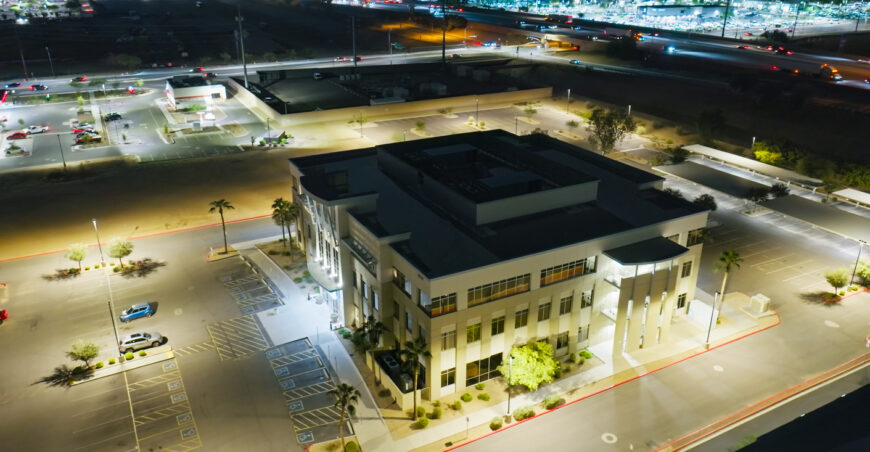
Phoenix medical office space is behaving exactly the way defensive assets are supposed to behave in an uncertain market: quietly, steadily, and profitably. While office towers wrestle with structural demand loss, industrial digests a historic wave of new supply, and even multifamily works through an oversupply hangover, medical office s[ace keeps leasing, keeps collecting rent, and keeps compressing in cap rate. It is now widely viewed as the most defensive asset class in U.S. commercial real estate, and Greater Phoenix sits at the center of that story.
That resilience is not an accident. It is rooted in demographics, in the inelastic nature of healthcare demand, and in a supply pipeline that never overbuilt the way other sectors did. New medical office space construction is set to fall to its lowest level in over a decade nationally, even as Arizona’s aging population keeps generating patients. The result in our market is telling: Phoenix medical office real estate posted 6.1% year-over-year rent growth at mid-year 2026, while capital rotated back into the sector nationally as investment volume jumped 78% year over year in early 2026.
For a metro like Greater Phoenix — one of the fastest-aging, fastest-growing in the country — those forces line up almost perfectly. It is why we are hearing the same question more and more from private buyers and institutions alike: how do I get into medical office in this market? What follows is what is actually driving the sector, where the real risks sit, and how investors, owners, and developers should be thinking about Phoenix medical office real estate right now.
Current Market Context
The broader capital markets backdrop is improving. National CRE investment activity is projected to rise 16% in 2026 to roughly $562 billion, nearly matching the pre-pandemic average, even as a wall of maturing debt keeps pressure on weaker assets. In that environment, capital gravitates toward income durability — and few sectors offer more of it than healthcare.
Nationally, medical office occupancy finished 2025 at 92.3% and is expected to climb further this year. Average MOB cap rates fell to 6.9% in Q1 2026, dipping below 7.0% for the first time since 2024 — a clear signal that investors are paying up for reliable healthcare income. The reason is simple: demand for medical care does not turn off in a downturn.
Medical Office Space: The Defensive CRE Play Phoenix’s Aging Boom Was Built For
Every property type has a story right now, but most of them are cautionary. Medical office is the exception — and Phoenix is where the case is clearest. To understand why, it helps to break the sector down into the forces actually driving performance on the ground.
Why Phoenix Medical Office Space Is Holding Firm
The case for Phoenix medical office real estate rests on three legs: durable tenant demand, disciplined supply, and demographics that keep the pipeline of patients growing. Start with demand. Healthcare is one of the few tenant categories that expands regardless of the economic cycle. People do not defer dialysis, cancer treatment, or orthopedic surgery because rates went up. That inelasticity is the foundation of the sector’s defensive reputation.
Now layer in supply discipline. Across the country, MOB completions are set to fall to their lowest level in more than a decade, pushing the average asking rent to a record high as growth accelerates to 1.4%. When you combine steady demand with shrinking new supply, you get exactly what landlords want — pricing power. Phoenix is feeling it directly.
In the Greater Phoenix market, vacancy declined to 12.6% in Q1 2026 with asking rents rising to $26.52 NNN, and the development pipeline hit a record 353,000-plus square feet — a sign that developers see the same durable demand we do. By mid-year, the metro was still posting positive net absorption and that 6.1% year-over-year rent growth. This is not a speculative run-up. It is a market where fundamentals are quietly tightening.
Local Arizona Impact: A Demographic Engine Under the Whole Sector
What makes Phoenix medical office space especially compelling is the demographic engine sitting underneath it. Arizona’s population is projected to grow by more than two million people, or 26%, by 2060, and metro Phoenix is expected to make up nearly three-quarters of the state’s residents. More people means more patients — and the age mix matters even more than the headline count.
The national picture frames it: the U.S. population aged 75 and older is growing by more than one million people a year, triple the pace of the past four decades. Arizona has long been a magnet for that cohort, and older residents are the heaviest users of outpatient care. Every retiree who relocates to Gilbert, Queen Creek, Scottsdale, or San Tan Valley adds incremental, recurring demand for imaging, cardiology, orthopedics, and primary care.
Then there is the supply-of-care problem. Arizona needs more than 8,000 additional doctors by 2030 to keep pace, and a large share of the current physician workforce is nearing retirement. A growing, aging population combined with a physician shortage is a recipe for sustained expansion of medical practices — and the buildings that house them. From Chandler to the West Valley, that dynamic supports occupancy and rent growth in ways few other property types can claim.
The National Backdrop
Phoenix is not an island. The same forces lifting the Valley are lifting medical office nationwide, which is exactly why capital is rotating into the space. Investment volume jumped 78% year-over-year in Q1 2026, and cap rates compressed as buyers competed for quality product. Americans aged 65 and older are projected to reach 73 million by 2030, up from 56 million in 2020 — a nationwide tailwind that will not reverse.
For Arizona owners, that national appetite is good news on the exit. Institutional buyers who want defensive healthcare income increasingly look to high-growth Sun Belt metros, and Greater Phoenix is near the top of that list. Strong local fundamentals plus deep national demand for the asset class is a favorable combination for anyone holding well-located medical product here.
Key Risks to Watch
No asset class is risk-free, and medical office has its own pressure points. The largest is policy. Proposed federal Medicaid reductions of nearly $1 trillion over ten years could squeeze providers with heavy Medicaid exposure, particularly in rural areas — a reminder that tenant credit and payer mix matter enormously in this sector.
Beyond policy, investors should watch construction costs and tenant improvement demands, which remain elevated and can erode returns on value-add deals. Interest rates, while more stable than in recent years, still set the floor on cap rates. And not all medical office is created equal — a purpose-built, hospital-affiliated building leased to a strong health system is a very different risk than an aging conversion with a single independent practice. Underwriting the tenant is just as important as underwriting the real estate.
Key Opportunities
For investors willing to do the work, the setup is unusually attractive. Multi-tenant buildings anchored by essential outpatient services — imaging, dialysis, surgery centers, primary care — offer diversified, sticky income. Suburban East Valley and West Valley submarkets, where population growth is fastest, are where new demand is being created fastest. And with new construction pulling back, existing well-located assets face less competition for tenants.
We are also watching the mixed-use healthcare campus trend closely. As health systems push care out of hospitals and closer to where patients live, integrated campuses that combine medical office space with complementary retail and services are becoming some of the most durable assets in the market. For developers with land in the path of growth, that model deserves a serious look.
The ICRE Perspective
What we are seeing in the field lines up with the data — but with more nuance than the headline numbers suggest. In conversations with owners across the Valley, the mood around medical office is confident, not frothy. Practices are signing longer leases. Health systems continue to expand outpatient footprints in the suburbs. And when a quality multi-tenant medical building comes to market, it draws a deeper buyer pool than almost anything else we handle.
The trend we think investors are underestimating is supply discipline. Everyone focuses on demographics, and rightly so. But the fact that so little new medical office is being built is what turns steady demand into real pricing power for existing owners. The opportunity many are missing is in the East Valley and West Valley growth corridors, where the population is arriving before the medical real estate does. Get positioned ahead of that curve and the demographics do the rest.
Our one caution: do not treat medical office as a monolith. The gap between a well-located, well-tenanted building and a marginal one is widening. This is a sector where local knowledge and tenant relationships genuinely change outcomes.
Investor Takeaways
- Lean into durability. Medical office offers the income stability that is hard to find elsewhere in CRE right now, with occupancy heading toward 93% to 94% nationally.
- Follow the rooftops — and the gray hair. Arizona’s aging, fast-growing population is the single most reliable demand driver for healthcare space through the end of the decade.
- Respect the supply story. With completions at a decade low, existing well-located buildings enjoy pricing power that new development will not quickly erode.
- Underwrite the tenant and the payer mix. Medicaid exposure and provider credit are the real risks in this sector — not vacancy.
- Move before the crowd. Cap rates are already compressing as capital rotates in; the best East Valley and West Valley basis is available now, not later.
Conclusion: A Rare Combination of Safety and Growth
The strategic takeaway is straightforward. Phoenix medical office space offers something increasingly rare in commercial real estate — a defensive income profile paired with a genuine growth story. The safety comes from inelastic healthcare demand and disciplined supply. The growth comes from one of the strongest demographic engines in the country.
Looking ahead, we expect the sector to keep outperforming through the rest of the decade as the 75-and-older population swells and Arizona’s physician shortage keeps demand for space elevated. Cap rate compression should continue as more institutional capital competes for quality product in high-growth Sun Belt metros like ours.
The action item: if medical office space is not yet part of your Arizona strategy, now is the time to evaluate it — before pricing fully catches up to the fundamentals. Whether you are buying your first outpatient building or repositioning a portfolio toward defensive income, the window to establish a favorable basis is open today.
How ICRE Can Help
At ICRE Investment Team, we specialize in helping investors, healthcare providers, and developers navigate the commercial real estate landscape — including the growing world of mixed-use healthcare assets. Whether you’re exploring your first medical office space investment, evaluating a portfolio opportunity, or looking to understand how healthcare campuses fit into a broader CRE strategy, our team has the market knowledge and relationships to help you move forward with confidence.
Healthcare real estate is not a passive play. It requires the right guidance, the right location analysis, and the right understanding of tenant needs. That’s exactly what we bring to every transaction.
Ready to stay ahead of the market? Join thousands of investors and CRE professionals who get our latest insights, market updates, and investment opportunities delivered straight to their inbox.
Sign up for the ICRE Newsletter here →
Don’t miss the next opportunity — subscribe today and let the ICRE Investment Team be your guide in one of the most resilient and fast-growing sectors in commercial real estate.
Related reading: The Growing Demand for Mixed-Use Commercial Real Estate Healthcare Campuses