

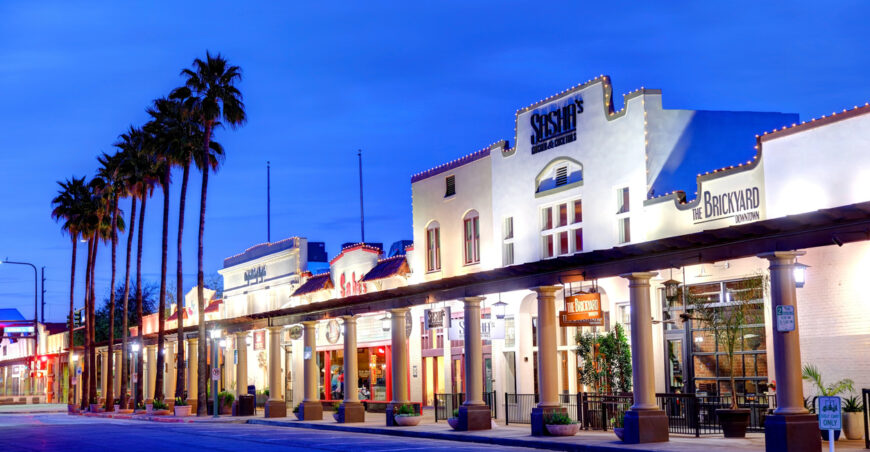
Phoenix retail real estate has quietly become the Valley’s tightest and most landlord-friendly commercial sector in 2026, and the numbers behind that shift are hard to ignore. While office wrestled with vacancy and multifamily worked through a supply wave, retail did something almost no one predicted five years ago: it ran out of space. Metro Phoenix retail vacancy sits at roughly 4.5%, with asking rents up nearly 7% year over year, a combination that hands pricing power squarely to owners and forces tenants to compete for well-located space.
This is not a local anomaly. Nationally, the U.S. retail vacancy rate has fallen to its lowest level in roughly 20 years, and the sector has now posted 11 straight quarters below 5% vacancy. Phoenix simply sits at the sharp end of that trend, powered by population growth, limited new construction, and steady consumer demand across the East Valley. For investors and property owners, the takeaway is direct: in Phoenix retail real estate, scarcity is the story, and scarcity favors whoever already owns the dirt.
Here’s what matters most in this market, at a glance:
- Vacancy is near record lows. Phoenix retail vacancy of about 4.5% is well below the national average and reflects a structurally undersupplied market.
- Rents are climbing. Phoenix retail asking rents rose roughly 6.97% year over year, outpacing the national retail rent-growth rate.
- New supply is scarce. Historically low construction deliveries mean little relief is coming, which protects existing owners’ occupancy and rents.
- Net lease is the sweet spot. Single-tenant NNN retail is trading at cap rates in the 5%–6% range, drawing passive and 1031 buyers to Phoenix pad sites.
- Tenant credit still matters. A tight market does not erase risk — a single dark box can undo a great location, so tenant quality and lease structure drive value.
Current Market Context
To understand why Phoenix retail real estate is behaving this way, start with what did not happen: developers never rebuilt the retail pipeline after the last cycle. Nationally, new retail supply is at historic lows, and construction lending for speculative retail has been scarce for years. When you stop adding space to a market that keeps adding people, vacancy compresses — and it stays compressed.
Consumer demand has held up better than the headlines suggested. U.S. retail asking rents reached about $24.79 per square foot in mid-2026, up 2.4% year over year, supported by tight supply and steady absorption. CBRE’s midyear outlook expects leasing momentum to carry into the second half of the year, which tells owners the demand side is not rolling over.
Phoenix magnifies all of it. The Valley absorbed more than 2.4 million square feet of retail space in fiscal 2025, and positive absorption paired with sub-5% vacancy has continued the momentum into 2026. That is the definition of a market where landlords, not tenants, hold the leverage.
Phoenix Retail Real Estate: Why the Valley’s Tightest Sector Is a Landlord’s Market in 2026
So why is Phoenix retail real estate specifically a landlord’s market, and not just a healthy one? Because three forces are stacking in owners’ favor at the same time: near-zero new supply, relentless in-migration, and a tenant base that has learned it cannot count on finding space when it needs it. When a growing national or regional retailer wants to be in Gilbert, Chandler, or Queen Creek, it is increasingly bidding for a finite number of quality boxes and pad sites — and that competition shows up as higher rents and shorter free-rent periods.
The pricing evidence is clear. Metro Phoenix retail asking rents climbed nearly 7% year over year, roughly triple the national pace. On the investment side, well-located single-tenant net-lease assets are trading at cap rates in the 5.0% to 6.0% range, with multi-tenant strip centers closer to 6.0% to 7.0%. Those yields reflect how confident buyers are in Phoenix retail cash flows.
It is worth being precise about what “landlord’s market” means here. It does not mean every retail property is a winner. It means that, all else equal, the balance of negotiating power has shifted toward ownership — renewal rents are firmer, concessions are thinner, and quality vacancies lease faster. We walked through this dynamic in detail in our earlier analysis of why Phoenix retail space has become a landlord’s market, and the fundamentals have only tightened since.
Local Arizona Impact: The East Valley Growth Engine
The clearest expression of Phoenix retail real estate strength is in the East Valley suburbs, where rooftops keep arriving ahead of shops. Mesa, Gilbert, Chandler, Queen Creek, and San Tan Valley have absorbed years of population growth, and retailers — grocers, quick-service restaurants, medical-retail, fitness, and service tenants — are chasing those households. Limited developable, well-located pad space in these submarkets is exactly why Phoenix retail sits near 4.5% vacancy while rents keep pushing higher.
Queen Creek and San Tan Valley are the frontier of that growth, where new master-planned communities create retail demand almost overnight. Gilbert and Chandler are more built-out, which makes their existing centers even more valuable — there simply isn’t much room to add competing supply. Local brokerage data continues to show tight availability and steady leasing across Phoenix retail submarkets, reinforcing that this is a metro-wide condition rather than a single-corridor story.
For Arizona owners, the practical implication is leverage. If you own a grocery-anchored center or a strong pad in the East Valley, your renewal conversations look very different than they did in 2021. For investors, the projection is straightforward: as long as Phoenix keeps adding residents faster than it adds retail square footage, the supply-demand imbalance — and the pricing power that comes with it — should persist well beyond 2026.
National Impact
Phoenix is riding a national wave, not fighting one. The U.S. retail sector’s sub-5% vacancy streak now spans 11 consecutive quarters, and structurally low construction means the scarcity is unlikely to resolve quickly anywhere. That national backdrop matters for Arizona owners because it keeps institutional and private capital hunting for retail exposure — and Phoenix, with its growth story, is near the top of the shopping list.
Capital is flowing accordingly. CBRE expects commercial real estate investment activity to rise in 2026, and retail’s defensive, income-driven profile fits what buyers want in a still-uncertain rate environment. For Phoenix, national demand for scarce, well-leased retail translates into deeper buyer pools and firmer pricing when quality assets come to market.
Key Risks
A landlord’s market is not a risk-free market, and Phoenix retail real estate carries real ones. The most immediate is tenant credit. A tight market can mask a weak tenant — until it can’t. When a single-tenant occupant fails, a great location becomes an empty box overnight. We covered exactly this scenario in our breakdown of Salad and Go’s collapse and what it means for net-lease retail in Gilbert, a reminder that lease structure and tenant quality still decide outcomes.
The second risk is financing. Commercial mortgage rates still start in the high-5% to mid-6% range, and more than $1.5 trillion in CRE loans mature through the end of 2026. Retail is far healthier than office, but leveraged buyers refinancing older, lower-rate debt will feel the squeeze on cash flow.
The third risk is complacency. Record-low vacancy can tempt owners to over-push rents or under-invest in tenant relationships. In a market this tight, the biggest self-inflicted wound is losing a strong, stable tenant to a competitor because the renewal was handled like a foregone conclusion.
Key Opportunities
The opportunities in Phoenix retail real estate are equally concrete. For owners, the clearest one is mark-to-market: rolling below-market leases to current rates as they expire, in a market where asking rents are up nearly 7% year over year. Each renewal is a chance to capture value that the tight market has already created.
For investors, single-tenant net lease remains the accessible entry point. With Phoenix NNN cap rates in the 5%–6% range, a well-located pad with a creditworthy tenant offers durable, largely passive income — the kind of asset that fits 1031 exchanges and long-hold strategies. Multi-tenant strip centers offer more yield and more upside for hands-on operators willing to manage tenant mix.
The subtler opportunity is location arbitrage in the growth corridors. Acquiring or developing pad space ahead of the rooftops in Queen Creek and San Tan Valley — where households are still arriving — lets patient capital buy into tomorrow’s tight market at today’s pricing.
The ICRE Perspective
Here’s what we’re seeing in the field. The Phoenix retail real estate market is tight, but it is not uniform — and that gap is where the money is made or lost. The best-located East Valley pads and grocery-anchored centers are effectively bulletproof right now, while tired, poorly-tenanted centers in weaker corridors still sit. Owners who assume “tight market” means “any property sells” are the ones who get surprised at the closing table.
What investors are missing is that the durability of this market is a tenant-credit and lease-structure question as much as a supply question. The scarcity is real and lasting, but underwriting a 5.5% cap on a single-tenant deal only works if that tenant survives the lease. We spend as much time on the tenant’s balance sheet and the lease’s guarantees as we do on the demographics.
The underestimated risk is refinancing, and the emerging opportunity is patience. Buyers who can close cleanly — with the right debt in place — are winning deals that over-leveraged competitors can’t. In a market where owners hold the leverage, the investors who prepare their capital stack in advance are the ones who actually get to use it.
Investor Takeaways
- Own scarcity. Well-located Phoenix retail — grocery-anchored centers and strong pads — benefits from a supply shortage that isn’t resolving soon.
- Underwrite the tenant, not just the location. A tight market hides weak credit until it fails; guarantees and lease structure protect your income.
- Net lease is the accessible play. Phoenix single-tenant NNN at 5%–6% cap rates offers durable, passive income suited to 1031 and long-hold buyers.
- Solve financing early. With rates elevated and a maturity wall ahead, clean, prepared capital is a competitive advantage.
- Follow the rooftops. Queen Creek and San Tan Valley offer growth-corridor entry points before those submarkets fully tighten.
Conclusion
The strategic takeaway is simple: Phoenix retail real estate is a landlord’s market because scarcity has replaced oversupply as the defining condition, and that shift rewards ownership. Record-low vacancy, rising rents, and thin new construction have handed pricing power to owners and turned well-leased retail into one of the Valley’s most resilient income assets.
Looking ahead, the outlook favors continuation over reversal. As long as metro Phoenix keeps adding residents faster than it adds retail square footage, the imbalance should hold — though rising financing costs and tenant-credit risk will separate the disciplined investors from the lucky ones. The winners will be those who pair great locations with strong tenants and a financing plan that is ready before the deal, not after.
The action item: if you own Phoenix retail, review your rent roll and upcoming lease expirations now to capture the mark-to-market this market has created. If you’re looking to buy, get your capital and debt lined up so you can move decisively when the right net-lease or growth-corridor asset appears. Our team can help you do both.
Related reading: A Landlord’s Market: Phoenix Retail Space and Salad and Go’s Collapse and the Future of Net Lease Commercial Real Estate in Gilbert, AZ.
How ICRE Can Help
At ICRE Investment Team, we specialize in helping investors, healthcare providers, and developers navigate the commercial real estate landscape — including the growing world of mixed-use healthcare assets. Whether you’re exploring your first medical office investment, evaluating a portfolio opportunity, or looking to understand how healthcare campuses fit into a broader CRE strategy, our team has the market knowledge and relationships to help you move forward with confidence.
Healthcare real estate is not a passive play. It requires the right guidance, the right location analysis, and the right understanding of tenant needs. That’s exactly what we bring to every transaction.
Ready to stay ahead of the market? Join thousands of investors and CRE professionals who get our latest insights, market updates, and investment opportunities delivered straight to their inbox.
Sign up for the ICRE Newsletter here →
Don’t miss the next opportunity — subscribe today and let the ICRE Investment Team be your guide in one of the most resilient and fast-growing sectors in commercial real estate.
Related reading: The Growing Demand for Mixed-Use Commercial Real Estate Healthcare Campuses