

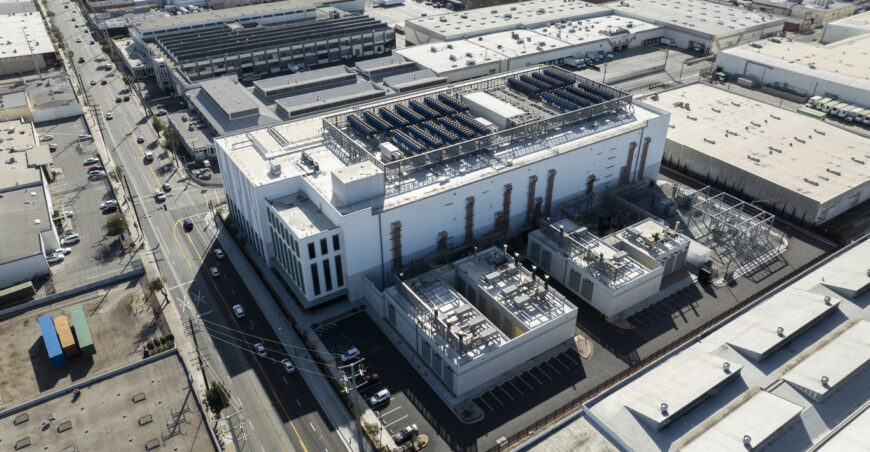
Data center real estate in Mesa has moved from a niche industrial story to one of the defining forces in Arizona’s commercial real estate market. What began as a handful of speculative land plays along the Elliot Road Technology Corridor has become a concentration of hyperscale campuses backed by the largest names in technology. The Phoenix metro, with Mesa at its center, is now a top-10 national data center hub with more than 125 facilities operating or under development.
But 2026 introduces a hard limit that few investors were pricing in two years ago: electricity. Demand from AI and cloud computing is still climbing, yet the ability to actually power these buildings has become the binding constraint — and that changes where value is created. The question is no longer whether the computing demand exists; it is whether the grid can deliver enough megawatts, fast enough, to keep the cranes moving. That single constraint is reshaping which projects pencil, which land is truly valuable, and where the next wave of opportunity sits. The winners will be the sites with secured power, and as this article lays out, the ripple effects — industrial demand, tax revenue, and infrastructure spending — extend well beyond the data halls themselves.
Current Market Context
The national picture is stark. Roughly 30% to 50% of large data centers scheduled to open in 2026 will be delayed or cancelled, not because demand softened, but because power, transformers, and grid interconnections cannot keep pace. High-power transformers now take three to five years to deliver, switchgear is sold out through 2028, and interconnection queues stretch three to seven years in major utility territories.
Capital is still eager. U.S. data center power demand is projected to reach 35 to 45 gigawatts by 2030 — roughly double 2024 levels, with about 100 gigawatts of new capacity anticipated between 2026 and 2030, equating to an estimated $1.2 trillion in real estate asset value. The money is there. The power is the bottleneck.
That backdrop is why broader commercial real estate investment is expected to rise 16% in 2026 to roughly $562 billion, with infrastructure-adjacent industrial and data center assets outperforming the field. Mesa sits squarely in that outperforming category.
Data Center Real Estate in Mesa, AZ: Arizona’s Boom Meets the Power Wall
Mesa’s advantage is concentration. The Elliot Road Technology Corridor has attracted a roster of hyperscale developers that reads like a who’s who of computing. Google’s Redhawk campus, at Elliot and Sossaman, has had Phase 1 operational since July 2025, with a 400-megawatt Phase 2 targeted for completion by May 2026. Meta is building a five-building campus in Mesa, a $1 billion greenfield development spanning more than 2.5 million square feet.
Independent operators have piled in alongside the hyperscalers. EdgeCore’s Mesa campus along the same corridor has expanded to 450 megawatts of total planned capacity, with its first phase already live and additional buildings under construction. This clustering matters: it creates the fiber, substation, and workforce density that makes the next project easier to build — a flywheel effect that is hard for newer markets to replicate.
For real estate investors, this is where data center real estate in Mesa diverges from a simple industrial play. The value is no longer just in the dirt or the shell — it is in the entitlements, the fiber routes, and above all the power commitments attached to a parcel. A site with a signed interconnection agreement is worth a multiple of an identical site without one.
Local Arizona Impact
Mesa itself is a city of roughly 516,000 residents — the third most populous in Arizona — anchoring a metro of about 5 million people that is projected to reach 5.2 million by 2028. That population base, paired with Arizona’s status as the nation’s No. 1 state for semiconductor expansion with more than 60 industry projects since 2020, gives Mesa a deep bench of infrastructure, talent, and supporting industrial demand.
The tax and infrastructure ripple is already visible. A 250-megawatt SRP and Aypa Power battery storage system in the Elliot Road Technology Corridor is expected to generate more than $16 million in economic impact, including roughly $14 million in property tax revenue over its first 20 years. Meta’s separate power arrangement through SRP and Ørsted centers on a 300-megawatt solar-plus-storage project representing a $1 billion investment, underscoring how data center demand is now driving Arizona’s energy buildout as well.
The strength of data center real estate in Mesa is also spilling into the broader industrial market. Metro Phoenix posted direct net absorption of 4.4 million square feet in the first quarter of 2026, its strongest quarter since early 2023, as data center construction, chip suppliers, and logistics tenants compete for space. Mesa is a primary beneficiary of that momentum.
National Impact
Mesa is a case study in a national reordering. For a decade, data center site selection was driven by land cost, tax incentives, and fiber. In 2026, it is driven first by available power. Markets that locked in generation and transmission early — Northern Virginia, parts of Texas, and Greater Phoenix — are consolidating their lead, while newer markets stall in interconnection queues.
Arizona’s response is aggressive. Governor Hobbs’ 2026 energy plan warns that proposed data center loads could nearly triple APS and SRP demand, requiring up to 29,000 megawatts of new power, and APS is building a 2-gigawatt natural gas plant in Gila Bend with a phase dedicated to serving large data center customers under a subscription model. How well the state executes on this buildout will help determine how much of the national data center pipeline Mesa can capture.
Key Risks
The most immediate risk is power availability. APS alone carries at least 10 gigawatts of pending interconnection requests and has committed to serving 4.7 gigawatts of new large-load demand over the next decade, most of it data centers. If generation lags, otherwise-promising Mesa sites could sit idle for years.
A second risk is concentration. A market defined by a handful of hyperscale tenants is exposed to shifts in their AI capital budgets. If one or two operators pause spending, the pipeline can thin quickly. Third, there is growing public and regulatory scrutiny over data centers’ impact on ratepayers, water, and the grid — a political variable that could tighten approvals or raise the cost of power going forward.
Key Opportunities
The flip side of a power-constrained market is that scarcity creates value. Sites with secured interconnection or on-site generation potential now command premium pricing. Investors who can assemble land near existing substations, or who can help bring behind-the-meter power to a parcel, are positioned to capture outsized returns.
The opportunity in data center real estate in Mesa also extends outward. Every hyperscale campus needs supporting industrial space, electrical and mechanical contractors, cooling and equipment suppliers, and workforce housing. For investors who find the marquee data center deals too competitive, the adjacent industrial, flex, and infrastructure plays offer a way to ride the same wave with less concentration risk.
The ICRE Perspective
What we are seeing in the field is a market bifurcating in real time. Two Mesa parcels that looked nearly identical in 2023 can now be worlds apart in value based on one factor: whether power has been secured. Investors who still underwrite these sites as generic industrial land are missing the point — the megawatt commitment is the asset.
We also think the smart money is looking one ring out. The headline hyperscale deals are fiercely contested and priced accordingly, but the second-order demand — industrial supply space, contractor yards, and the healthcare and residential development that follows thousands of new construction and operations jobs — is where patient capital can still find room. Data center real estate in Mesa is not just a technology story; it is a catalyst reshaping the entire East Valley economy.
Investor Takeaways
- Underwrite power, not just land. A Mesa parcel with a secured interconnection agreement is worth a multiple of one without. Make grid access the first question, not the last.
- Respect the flywheel. The Elliot Road corridor’s existing fiber, substation, and workforce density lowers execution risk for the next project — a durable competitive moat for Mesa.
- Play the second ring. Supporting industrial, flex, and infrastructure assets offer exposure to the boom with less tenant concentration risk than the hyperscale deals themselves.
- Watch the regulatory and power buildout. Arizona’s ability to add 29,000 megawatts of new capacity will determine how much of the national pipeline Mesa ultimately captures.
Conclusion
The strategic takeaway is simple: in 2026, power is the product. Data center real estate in Mesa remains one of the most compelling growth stories in American commercial real estate, but the source of value has migrated from location to electricity. Investors who internalize that shift will underwrite differently — and better — than those still working from an old playbook.
Looking ahead, expect Mesa to keep gaining share as Arizona brings new generation online, even as the national pipeline thins under power constraints. The metro’s concentration, its semiconductor-driven industrial base, and its aggressive utility posture position it to absorb demand that stalls elsewhere. The action item for investors and owners is to move now on secured-power sites and adjacent opportunities, before the market fully prices the scarcity that is already reshaping it.
How ICRE Can Help
At ICRE Investment Team, we specialize in helping investors, developers, and property owners navigate the commercial real estate landscape — including the fast-growing world of data centers and their commercial real estate footprint. Whether you’re evaluating a power-secured land play, a portfolio opportunity, or looking to understand how data center demand fits into a broader CRE strategy, our team has the market knowledge and relationships to help you move forward with confidence.
Data center and infrastructure real estate is not a passive play. It requires the right guidance, the right location and power analysis, and the right understanding of tenant needs. That’s exactly what we bring to every transaction.
Ready to stay ahead of the market? Join thousands of investors and CRE professionals who get our latest insights, market updates, and investment opportunities delivered straight to their inbox.
Sign up for the ICRE Newsletter here →
Don’t miss the next opportunity — subscribe today and let the ICRE Investment Team be your guide in one of the most resilient and fast-growing sectors in commercial real estate.
Related reading: Impact of Data Centers on the Commercial Real Estate Footprint