

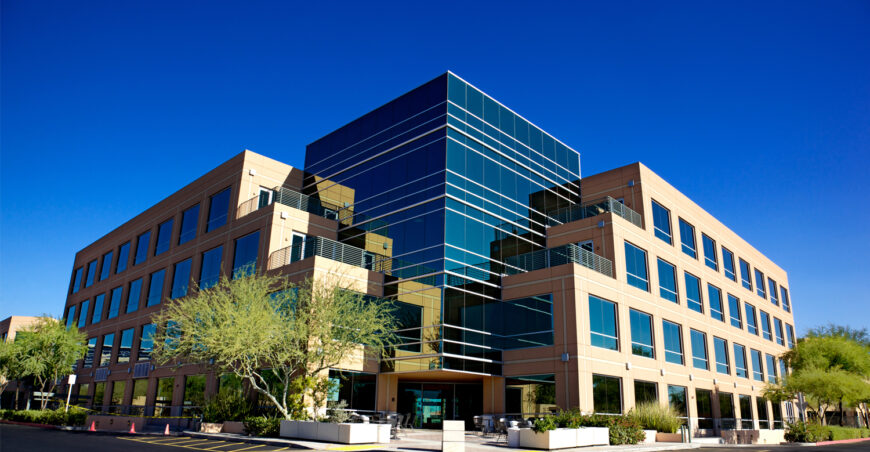
Office to medical conversion in Phoenix has moved from a niche repositioning play to one of the most practical answers to the Valley’s office problem. Traditional office is still working through high vacancy, with Kidder Mathews putting metro Phoenix total office vacancy at 23.7% in the third quarter of 2026, down just 10 basis points from a year earlier. At the same time, well-located medical space remains hard to find.
That gap is the opportunity. One side of the market has too much space and not enough tenants. The other has growing patient demand, a thin construction pipeline, and buyers willing to pay up for stable medical income. Converting the right office building closes that gap, but only when the building, the location, and the numbers all line up.
Five things every Phoenix office owner and investor should know right now:
- Conversions are now a national trend. CBRE expects conversions to account for a record share of healthcare construction in 2026, and office buildings supply about 42% of them.
- The Phoenix office recovery has slowed. Third-quarter leasing fell from the prior quarter, and older core buildings are losing tenants to premium space.
- Phoenix medical office is tightening. Direct vacancy fell to 15.1% in Q2 2026, rents rose, and no new medical buildings delivered during the quarter.
- Medical buildings hold value better. In Phoenix, 89% of medical office properties that resold since 2024 appreciated, versus 65% of traditional office.
- Not every building qualifies. Ceiling height, plumbing, parking, and proximity to hospitals and rooftops decide whether a conversion works.
This article explains what is driving office to medical conversion in Phoenix, where it makes the most sense, what it costs, and how owners and investors should position for it.
Current Market Context
The Phoenix office market spent the first half of 2026 improving, then lost momentum. Kidder Mathews reported only 23,600 square feet of positive direct net absorption in Q3 2026, and total leasing slipped to about 1.3 million square feet. We covered the earlier part of that story in our 2026 Phoenix Office Market Trends analysis. The third quarter shows the recovery narrowing.
The divide is now between winners and everyone else. Marcus & Millichap reports that Central Corridor vacancy jumped 300 basis points to 26.5%, while the Camelback Corridor and North Scottsdale emerged as bright spots. Banner Health’s planned move from roughly 304,000 square feet at Phoenix Plaza to 67,000 square feet at Bond Phoenix is a clear example of tenants trading older, larger space for smaller, premium space.
Medical office is moving the other way. Kidder Mathews reported Phoenix medical office direct vacancy fell from 15.8% to 15.1% in Q2 2026, while average full-service rents rose from $33.80 to $34.39 per square foot. Sales volume climbed to $151.8 million from $88.9 million the quarter before.
Office to Medical Conversion in Phoenix, AZ: A Second Life for Vacant Office
Nationally, conversions have become a real source of medical space. CBRE’s 2026 midyear outlook projects that conversions will make up a record 5.5% of all healthcare construction in 2026. About 42% of those projects start as traditional office and 43% start as retail. CBRE also notes that elevated construction and financing costs are pushing many new medical deliveries out to 2027, which makes existing buildings more valuable.
The logic is simple. A ground-up medical building takes land, entitlements, and a long construction schedule. An existing office building already has a frame, an envelope, a parking field, and an address. When it sits close to patients and hospitals, it can reach the market faster than new construction.
The cost case is real but not automatic. Industry project reviews from Building Design + Construction found that reusing a building’s site, frame, and envelope can save roughly 20% to 30% versus new construction, depending on existing conditions. On the other side of the ledger, MMCG Invest cites JLL’s 2026 guide pegging all-in medical fit-out at about $412 per square foot from a warm shell. Those two numbers explain why office to medical conversion in Phoenix works on some buildings and fails on others.
What makes a good candidate. The buildings that convert well usually share a few traits:
- Location near care and rooftops. Proximity to a hospital campus or a fast-growing residential area drives physician demand.
- Low-rise, easy access. Single- and two-story buildings with drive-up access and surface parking compete best with patients.
- Workable floor heights. Healthcare designers generally recommend at least 13 feet floor-to-floor. Many older offices sit at 10 to 11 feet.
- Upgradeable systems. Plumbing, HVAC zoning, power, and elevators sized for stretchers often need major work.
- A rent spread that pays for it. The medical rent premium must cover the fit-out, downtime, and leasing costs.
Local Arizona Impact
The demand behind office to medical conversion in Phoenix starts with population. The Maricopa Association of Governments estimates Maricopa County reached 4,787,790 residents in July 2025, adding 62,162 people in one year and more than 362,000 since the 2020 Census. Phoenix alone added nearly 16,000 residents, Buckeye added about 5,400, Mesa added about 3,800, and the Maricopa County portion of Queen Creek added about 3,500.
Healthcare jobs are growing with it. The Greater Phoenix Economic Council reports about 273,700 people working in Phoenix healthcare, a 22% increase since 2016. Its projections call for nurse practitioner jobs to grow 17% and medical assistant jobs to grow 8% between 2025 and 2028. Statewide, the Arizona Governor’s Office reports private education and health services was the fastest-growing sector, adding about 11,800 jobs year over year as of spring 2026.
Conversions are already changing local results. According to CoStar, Chandler led the Valley’s medical office demand last year, driven by move-ins at an office-to-medical conversion. CoStar also reports that single-story medical buildings are near a decade-low vacancy of 6.8%, which shows how much tenants value easy access. Developers delivered about 329,000 square feet of new medical office in 2025, less than the market absorbed.
There are visible local examples. Transwestern highlights the Chandler Integrated Care Campus as a retail-to-medical conversion. In Deer Valley, ViaWest Group repositioned the 252,350-square-foot Blackhawk Corporate Center near a major hospital campus and sold it 96% leased to a mix of office and medical users. On West Dunlap Avenue, the 139,709-square-foot Concorde Medical Center near three hospital campuses is currently being marketed as an office-to-medical conversion opportunity.
The forward pipeline points the same way. CoStar counts about 518,000 square feet of medical office under construction, the largest pipeline since late 2020, but that is small for a metro adding more than 60,000 people a year. CBRE expects national medical vacancy to end 2026 near 9.7%, and tight supply should keep Phoenix landlords in a strong position through 2027.
National Impact
Nationally, medical office has become the clear outperformer inside the office sector. Commercial Cafe data reported by CRE Daily shows medical office made up 26.2% of office construction starts, up from 11% five years earlier. Overall office starts fell 73% since 2020, while medical starts fell only 9.5%.
Capital is following. Cushman & Wakefield reported $6.7 billion of medical office investment in the first half of 2026, up 21% from a year earlier, with larger average deal sizes. MMCG Invest puts the average medical office cap rate at 6.9% in Q1 2026, while national traditional office vacancy sits between 18.6% and 21% depending on the source.
Phoenix stands out even in that strong national picture. AZ Big Media, citing CommercialCafe, reports that 89% of Phoenix medical office properties that resold since 2024 appreciated, compared with 65% of traditional office. Only Tampa posted a higher rate.
Key Risks
Submarket risk. Medical demand is not uniform. Kidder Mathews’ Q2 2026 submarket data shows Northwest Phoenix medical direct vacancy at 28.1%, versus 12.8% in Midtown/Central Phoenix. A conversion in the wrong submarket simply trades one vacancy problem for another.
Building risk. Low ceilings, undersized plumbing, weak HVAC zoning, and elevators that cannot handle stretchers can turn a budget upside down. Project teams consistently advise budgeting for a full HVAC replacement from the start.
Tenant credit risk. CBRE notes that healthcare providers face high operating costs and shrinking reimbursement rates. A long lease is only as strong as the practice or health system behind it.
Cost and timing risk. With fit-outs above $400 per square foot in some cases, every month of downtime matters. Office to medical conversion in Phoenix only pencils when the rent premium and leasing velocity cover the capital and carry.
Key Opportunities
Buy the basis. Phoenix office assets traded around $184 per square foot on average through June, according to CommercialEdge. Medical assets trade far higher, such as Montecito Medical’s $25.1 million purchase of 1675 E. Melrose in Chandler at about $509 per square foot. That spread is the core of the conversion thesis.
Target Class B. Kidder Mathews’ Q2 data shows Class A office vacancy at 28.1% and Class B at 18.4%. Smaller, older Class B buildings near hospitals and new rooftops are often the best fit, because they offer low-rise layouts and a lower entry price.
Blend the tenancy. Conversions do not have to be all or nothing. Blackhawk Corporate Center showed that a mix of office and medical users can stabilize a building while the medical share grows over time.
Sell to medical buyers. Medical office buildings accounted for about one-third of all Phoenix office sales in 2025, more than double their historical share, according to CoStar. A stabilized conversion opens the door to a deeper buyer pool of healthcare REITs and private medical investors.
The ICRE Perspective
In the field, we are seeing medical tenants tour space that would never have been on their list three years ago. Practices are priced out of new construction and cannot wait until 2027 for the next ground-up delivery. A well-located office building that can be delivered in months, not years, wins that conversation.
What many owners miss is that the decision starts outside the building. We look at drive times, patient demographics, nearby hospital campuses, and which specialties are underserved before anyone prices a fit-out. A building three minutes from a hospital and surrounded by new rooftops is a medical candidate. The same building in an oversupplied medical submarket is not.
The risk being underestimated is the capital stack. Office to medical conversion in Phoenix often needs fresh equity for tenant improvements and leasing costs, and lenders underwrite the medical rent roll, not the vision. Owners who start with a signed anchor practice or health system have a far easier path to financing and a stronger exit.
Owner and Investor Takeaways
- Start with location: Hospital proximity, rooftop growth, and drive-up access matter more than the building’s current condition.
- Inspect the bones early: Check floor-to-floor heights, plumbing capacity, HVAC, power, and elevators before you underwrite rents.
- Underwrite the spread: Compare your all-in basis after fit-out to medical sale comps and rents, not to office comps.
- Check the submarket: Medical vacancy ranges from low teens to nearly 30% depending on where you are in the Valley.
- Lead with a tenant: An anchor practice or health system commitment de-risks the project and improves financing.
- Consider a phased approach: Blending office and medical tenants can keep income flowing while the building transitions.
Reach Out To ICRE for A New Office to Medical Conversion in Phoenix, AZ
The strategic takeaway is clear. Phoenix has more traditional office space than it needs and less quality medical space than it needs, and the right building can serve the second market instead of struggling in the first. Office to medical conversion in Phoenix turns that mismatch into value for owners who choose the right asset in the right location.
Looking ahead, new medical construction remains limited by cost and financing, healthcare employment keeps climbing, and the Valley continues to add more than 60,000 residents a year. That combination should keep medical demand ahead of supply into 2027, and conversions will fill a growing share of the gap.
The action item: if you own or are evaluating an older office building near a hospital or a growing East Valley or West Valley community, get a conversion feasibility review now, before you sign another office renewal or reprice the space.
How ICRE Can Help
At ICRE Investment Team, we specialize in helping investors, healthcare providers, and developers navigate the commercial real estate landscape — including the medical office growth now unfolding in Gilbert. Whether you’re exploring your first medical office investment, evaluating a portfolio opportunity, or looking to understand how healthcare campuses fit into a broader CRE strategy, our team has the market knowledge and relationships to help you move forward with confidence.
Healthcare real estate is not a passive play. It requires the right guidance, the right location analysis, and the right understanding of tenant needs. That’s exactly what we bring to every transaction.
Ready to stay ahead of the market? Join thousands of investors and CRE professionals who get our latest insights, market updates, and investment opportunities delivered straight to their inbox.
Sign up for the ICRE Newsletter here →
Don’t miss the next opportunity — subscribe today and let the ICRE Investment Team be your guide in one of the most resilient and fast-growing sectors in commercial real estate.