
Recently, Michael Douglas with the ICRE Investment Team attended a CCIM Central Arizona Chapter breakfast, where the keynote presentation was delivered by the Greater Phoenix Economic Council (GPEC). The presentation provided valuable insights into the regional economy, growth trends, and the forces shaping commercial real estate across Arizona.
The data and analysis presented reinforced a message many professionals in commercial real estate already recognize: Greater Phoenix continues to emerge as one of the most dynamic economic regions in the United States, driven by strong population growth, corporate relocation activity, and a rapidly diversifying economy.
Arizona’s Economic Growth is Outpacing the Nation
One of the most notable statistics presented during the event highlighted Arizona’s economic strength relative to national trends.
In 2024, Arizona’s GDP grew by 4.5%, significantly outpacing the U.S. real GDP growth rate of 2.8% during the same period. This performance underscores the state’s favorable business climate, strong in-migration trends, and expanding industrial base.
Since the recovery following the 2008 financial crisis, Arizona has steadily transformed into a major destination for companies relocating from higher-cost states. The combination of business-friendly policies, competitive operating costs, and a growing workforce continues to attract companies across multiple sectors.
For commercial real estate professionals, this growth translates into sustained demand across industrial, office, healthcare, and logistics properties throughout the Phoenix metro area.
The Role of GPEC in Driving Regional Growth
The Greater Phoenix Economic Council (GPEC) plays a central role in attracting new companies and investment to the region. GPEC works closely with 22 cities and towns across Maricopa and Pinal counties, coordinating economic development efforts and supporting companies evaluating relocation to Greater Phoenix.
Their services include:
• Market comparisons for taxes, labor, and operating costs
• Real estate and site selection analysis
• Infrastructure readiness and utilities coordination
• Workforce development connections with local universities
• Incentive analysis and economic impact projections
These services are provided at no cost to companies, as GPEC is funded through partnerships with municipalities and private sector investors.
Currently, approximately 80% of GPEC’s deal activity involves industrial users, reflecting the rapid growth of logistics, advanced manufacturing, and supply chain operations in the region.
Phoenix’s Expanding Industrial Corridors
One of the major themes from the presentation was the rapid expansion of industrial development beyond Phoenix’s traditional core markets.
The Loop 303 corridor and the I-10 West corridor have emerged as major industrial hubs attracting warehouse, distribution, and manufacturing companies. Initially, many developers were skeptical about outer market areas such as Casa Grande and Coolidge, but that perception has shifted dramatically.
Major investments from companies such as Lucid Motors and Kohler have validated the long-term growth potential of these markets.
Communities like Florence and San Tan Valley are also seeing increased attention as companies seek larger development sites, workforce availability, and proximity to Phoenix’s growing logistics infrastructure.
This geographic expansion reinforces Phoenix’s role as a strategic logistics gateway connecting the West Coast supply chain with the rest of the country.
Current Makeup of Industry in Greater Phoenix
Another important insight from the presentation was the diversification of Greater Phoenix’s employment base, illustrated in the slide highlighting the Current Makeup of Industry.
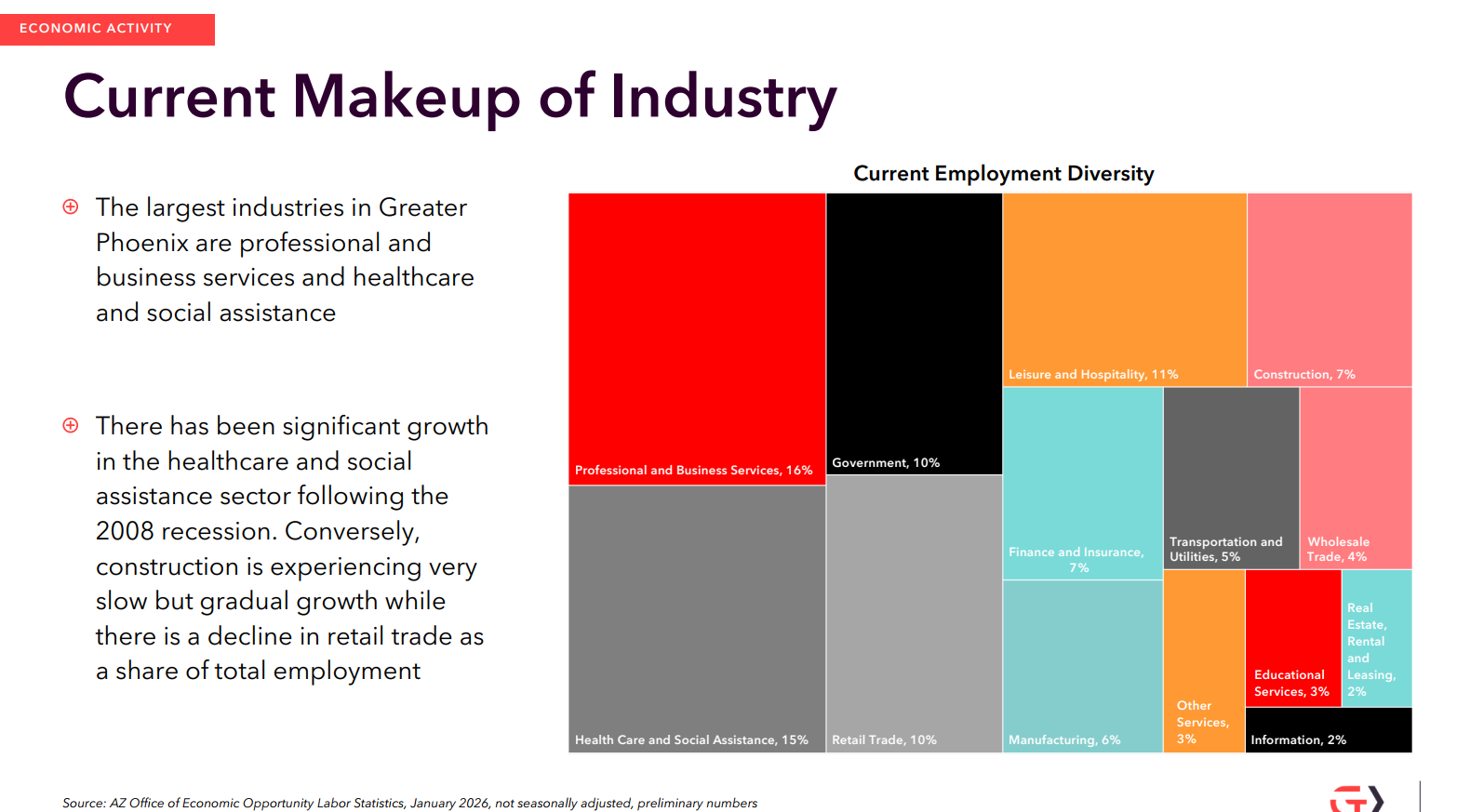
Of the industries shown in the presentation, professional and business services account for approximately 16% of total employment, making it the largest industry sector in Greater Phoenix.
Closely behind is healthcare and social assistance, representing roughly 15% of employment, highlighting the significant role healthcare plays in the region’s economy.
Other major sectors include:
• Government – 10%
• Retail Trade – 10%
• Leisure and Hospitality – 11%
• Construction – 7%
• Finance and Insurance – 7%
• Manufacturing – 6%
One of the most important takeaways is the strong growth of the healthcare sector following the 2008 recession. Healthcare continues to expand as Arizona’s population grows and the region attracts retirees, families, and workforce migrants. For commercial real estate, this growth translates directly into increased demand for medical office buildings, healthcare campuses, outpatient facilities, and specialized medical space throughout the metro area.
Housing and Affordability Trends
Housing affordability was another major topic discussed during the presentation. Phoenix’s cost of living currently sits about 3.3% above the national average, while housing costs are roughly 10% higher than the U.S. average. Despite this increase, Phoenix remains far more affordable than many Tier-1 cities such as Los Angeles, San Francisco, Seattle, and Washington D.C.
The data also showed that 36% of the median household income is required to afford the median home price, which aligns almost exactly with the national average.
This alignment indicates that income growth in the region is helping offset rising housing prices, allowing Phoenix to remain competitive in attracting both companies and talent.
A Strong Corporate Relocation Pipeline
Another highlight from the presentation was GPEC’s active economic development pipeline.
As of the latest update, GPEC is working on 26 potential corporate relocation projects, with projections suggesting the region could close 40 to 50 new company relocations this fiscal year.
The current pipeline represents:
• $67 billion in potential capital investment
• 27,000 new jobs
• Approximately 32 million square feet of new industrial and office demand
Industrial projects dominate the pipeline, particularly in advanced manufacturing, logistics, and supply chain operations.
Office relocations are increasingly focused on regional headquarters and advanced back-office operations, reflecting the shift toward higher-value employment sectors rather than traditional call center operations.
Infrastructure and Energy Planning
Rapid economic growth brings infrastructure challenges, and energy demand was another major topic discussed during the presentation.
Phoenix’s peak power demand currently sits at approximately 8,600 megawatts, and utilities are planning to double capacity within the next 10 to 15 years to accommodate new development.
Future energy investments include:
• Natural gas generation
• Solar energy expansion
• Battery storage systems
• Potential nuclear energy development
These investments are essential to support high-power industries such as semiconductor manufacturing, data centers, and advanced manufacturing facilities.
What This Means for Commercial Real Estate in Greater Phoenix
Arizona’s economic momentum is creating a ripple effect across the commercial real estate market. As companies continue relocating to the region and existing businesses expand, demand for industrial facilities, office space, medical office buildings, and retail centers continues to grow. Population growth, job creation, and industry diversification are all contributing to stronger real estate fundamentals throughout Greater Phoenix.
For businesses, this growth means increased competition for well-located commercial space and the importance of making strategic real estate decisions early. Whether a company is expanding operations, entering the Arizona market, or repositioning its footprint, having the right location and lease structure can significantly impact long-term success.
The ICRE Investment Team works with companies, investors, and healthcare providers to navigate these opportunities. Our team provides support with site selection, demographic and market analysis, lease negotiations, and acquisitions and dispositions of commercial real estate helping businesses identify locations that align with their operational goals while staying ahead of Arizona’s continued economic growth.
If your organization is evaluating expansion or relocation opportunities in Greater Phoenix, the ICRE Investment Team would be happy to help guide the process and provide strategic insight into one of the fastest-growing markets in the country. From site selection and market analysis to lease negotiations and real estate acquisitions, our team works with businesses to identify the right opportunities in a rapidly evolving market. To learn more or start the conversation, visit our Contact Us page